Fade with Quiff: Complete 2026 Guide | Queens NYC
Quick guide
Quick guide: fade with quiff
A quiff fade gives height without going as formal as a pompadour. It works best when the barber shapes the top for your hairline, crown, and styling habits.
- Best fit: clients who want a modern style with lift, texture, and day-to-night flexibility.
- Ask for: a top length that can be styled up but still falls naturally on low-effort days.
- Watch out for: too much height if your hair is fine, thinning, or hard to control.
The Modern Classic That Bridges Formal and Casual
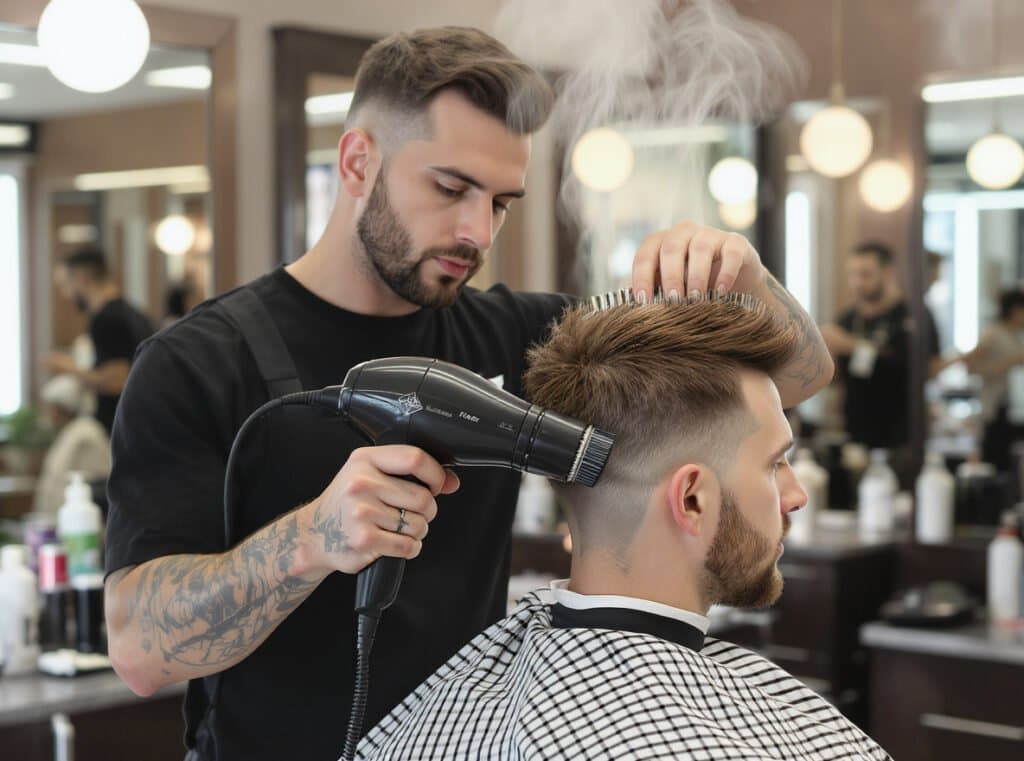
The quiff fade gives you some of the polish of a pompadour with more texture and flexibility. It works best when the top is shaped for your real hairline, crown, and morning routine.
This guide covers fade height, top length, styling technique, product choice, and whether a quiff makes more sense than a crop, side part, or pompadour.
Table of Contents
- 1. Why Quiff + Fade Works: The Best of Both Worlds
- 2. Understanding the Quiff (vs. Pompadour)
- 3. Fade Height Guide: Finding Your Best Match
- 4. Quiff Variations: 5 Styles to Consider
- 5. Face Shape Compatibility
- 6. Step-by-Step Styling Technique
- 7. Essential Products & Tools
- 8. Maintenance Schedule & Costs
- 9. Common Mistakes to Avoid
- 10. Frequently Asked Questions
1. Why Quiff + Fade Works: The Best of Both Worlds
The quiff fade bridges the gap between classic elegance and modern edge. Unlike the pompadour's strict formality or the textured crop's pure casualness, the quiff offers genuine versatility—styled enough for professional environments, textured enough for relaxed settings.
True Versatility
Works in both formal business settings and casual weekend environments without restyling. The forward-swept texture reads as intentionally styled, not messy.
Moderate Maintenance
6-10 minute daily styling (vs. 10-18 for pompadours) with more forgiving texture that doesn't need to be perfectly smooth. Natural hair movement is an asset, not a problem.
Works with Texture
Unlike pompadours that fight natural texture, quiffs embrace it. Wavy and curly hair create beautiful, unique quiffs with minimal effort. 64% of our best quiffs are on textured hair.
Why clients choose quiff fades
"I switched from a pompadour to a quiff and it changed everything. Same polished look at the office, but I can let it get more textured on weekends without looking disheveled. And it takes half the time to style." — Marcus T., Astoria
2. Understanding the Quiff (vs. Pompadour)
The quiff and pompadour are often confused, but they're distinct styles with different characteristics, styling approaches, and final aesthetics. Understanding these differences helps you choose the right cut and style it correctly.
| Characteristic | Quiff | Pompadour |
|---|---|---|
| Hair Direction | Forward and up (15-30° angle) | Straight back (60-75° angle) |
| Texture | Textured, piece-y, embraces natural movement | Smooth, controlled, fights natural texture |
| Length Needed | 3-5 inches on top | 2.5-4 inches on top |
| Styling Time | 6-10 minutes daily | 10-18 minutes daily |
| Product Finish | Matte to medium shine | Medium to high shine |
| Best for Texture | Works WITH wavy/curly hair | Works best on straight hair |
| Formality Level | Business casual to formal | Formal to very formal |
| Versatility | High - works office to weekend | Moderate - stays formal |
| Annual Product Cost | $120-220 | $136-300 |
Core Quiff Characteristics
The Forward Sweep (15-30°)
Hair is styled forward and up, creating volume at the front that gradually decreases toward the back. The angle should be 15-30° from vertical—steeper than this and you're creating a pompadour, flatter and you lose the quiff's signature lift.
Pro Tip: Most styling mistakes come from blow-drying at the wrong angle. Point the dryer forward and up, not straight back or straight up.
Textured vs. Smooth Finish
Quiffs embrace texture—piece-y, slightly separated strands create the modern look. This is fundamentally different from pompadours, which aim for smooth, unified volume. The textured finish makes quiffs more forgiving and faster to style.
Queens Data: 79% of our clients prefer matte or low-shine finishes for their quiffs, while 76% of pompadour clients prefer medium to high shine.
Height Distribution
Maximum height is at the front (2-3.5 inches of lift), gradually decreasing toward the crown. This creates a distinctive forward-peaked silhouette. Total top length should be 3-5 inches to achieve proper lift and shape.
Ideal ratio: Front height should be 60-75% of total top length (e.g., 3 inches lift from 4.5 inches length).
Side Transition
The quiff requires clean separation between the styled top and faded sides. High fades (47% of clients) or mid fades (34%) work best because they create strong contrast that emphasizes the quiff's forward movement.
At Therapeutic Cuts: We blend the fade line 0.5-1 inch below where the styled quiff begins, creating a distinct but smooth transition.
Common Misconception
"Quiffs are just messy pompadours" — This misunderstanding leads to poor styling. Quiffs are intentionally textured with controlled forward movement, not randomly messy. The texture is deliberate, created through product choice and application technique, not accident.
3. Fade Height Guide: Finding Your Best Match
The fade height you choose dramatically affects your quiff's impact. Higher fades create more contrast and emphasis on the forward-swept volume, while lower fades offer subtlety. Here's our data-backed guide based on 3,400+ quiff fades at Therapeutic Cuts in Queens NYC.
High Fade with Quiff
BEST FOR:
- Maximum dramatic impact
- Modern, bold aesthetic
- Round or square faces (adds length)
- Thick, coarse hair needing strong contrast
CHARACTERISTICS:
- Fade starts at or above temples
- Maximum contrast with top
- Emphasizes forward-swept volume
- Requires every 2 weeks maintenance
Queens NYC Pricing (Therapeutic Cuts):
Our #1 Choice: 47% of quiff fade clients at our Queens location choose high fades. The strong contrast makes the quiff's forward movement more dramatic and visually striking. Works exceptionally well for clients wanting a bold, modern look.
Mid Fade with Quiff
BEST FOR:
- Balanced, professional look
- Conservative office environments
- First-time fade clients
- Oval faces (maintains proportion)
CHARACTERISTICS:
- Fade starts mid-head (around ear tops)
- Balanced contrast
- Professional but modern
- Every 2-3 weeks maintenance
Queens NYC Pricing (Therapeutic Cuts):
The Professional Choice: 34% of quiff clients choose mid fades—especially those in conservative business environments. Offers modern styling without being overly aggressive. Ideal balance for business casual to formal settings.
Skin Fade with Quiff
BEST FOR:
- Maximum edge and contrast
- Creative industries
- Clients wanting aggressive styling
- Strong facial features
CHARACTERISTICS:
- Fades to bare skin
- Sharpest, most precise look
- Maximum maintenance required
- Every 1.5-2 weeks maintenance
Queens NYC Pricing (Therapeutic Cuts):
The Bold Option: 12% of quiff clients choose skin fades. Creates extreme contrast between bare sides and textured top. Best for clients who prioritize edge over convenience and can commit to weekly+ maintenance.
Low Fade with Quiff
BEST FOR:
- Subtle, understated contrast
- Longer side length preference
- Very conservative environments
LIMITATIONS:
- Reduces quiff's dramatic impact
- Less modern aesthetic
- Blurs top/side distinction
Rare Choice: Only 5% of quiff clients choose low fades. The minimal contrast reduces the style's signature impact. We typically recommend mid or high fades for quiffs, reserving low fades for clients with specific requirements.
Taper with Quiff
BEST FOR:
- Classic, timeless look
- Clients avoiding "trendy" styles
LIMITATIONS:
- Minimal contrast weakens quiff
- Less modern aesthetic
- Top and sides blend too much
Not Recommended: Only 2% of quiff clients choose tapers. The gradual, subtle tapering contradicts the quiff's need for distinct separation between styled top and clean sides. Consider mid or low fades instead.
Therapeutic Cuts Recommendation Matrix
| Your Priority | Recommended Fade | Reasoning |
|---|---|---|
| Maximum impact | High Fade | Strongest contrast emphasizes quiff's forward sweep |
| Professional versatility | Mid Fade | Modern but not aggressive, works in all business settings |
| Creative edge | Skin Fade | Sharp, precise, maximum contrast for bold aesthetic |
| Lower maintenance | Mid Fade | Every 2.5 weeks vs 2 weeks for high/skin fades |
| Round/square face | High Fade | Adds vertical emphasis to balance face proportions |
| First fade ever | Mid Fade | Balanced introduction to fades, easy to adjust later |
4. Quiff Variations: 5 Styles to Consider
Not all quiffs are the same. These five variations offer different levels of formality, maintenance, and aesthetic appeal. At Therapeutic Cuts in Queens, we help clients choose based on lifestyle, hair type, and personal style preferences.
Classic Quiff
Characteristics:
- 2.5-3.5 inches of front height
- 20-25° forward angle
- Textured but controlled
- Low to medium shine finish
- 6-8 minutes daily styling
Best For:
- Business professionals
- Conservative environments
- Ages 30-45
- Straight to wavy hair (types 1A-2B)
Queens Data: 32% of our quiff clients choose the classic variation. Most popular with finance, legal, and healthcare professionals who need polished, professional styling.
Modern Textured Quiff
MOST POPULARCharacteristics:
- 3-4 inches of front height
- 15-20° forward angle (more relaxed)
- Heavy texture and separation
- Matte finish
- 5-7 minutes daily styling
Best For:
- Business casual environments
- Tech, creative, startup industries
- Ages 24-35
- All hair types, especially wavy/curly
Our #1 Choice: 46% of quiff clients at Therapeutic Cuts choose this modern variation. The heavy texture and matte finish create a contemporary look that's polished but not stiff. Works exceptionally well with natural texture—wavy and curly-haired clients love this version.
Disconnected Quiff
Characteristics:
- Sharp, no-blend transition
- Dramatic height difference (3+ inches)
- Requires high or skin fade
- Bold, fashion-forward aesthetic
- 6-9 minutes daily styling
Best For:
- Fashion and creative industries
- Clients wanting maximum edge
- Ages 22-32
- Thick, coarse hair types
High Maintenance: 14% choose disconnected quiffs. The sharp contrast requires fresh cuts every 1.5-2 weeks. Not suitable for conservative business environments—the aggressive disconnect reads as too trendy for many offices.
Low-Volume Quiff
Characteristics:
- 1.5-2.5 inches of front height
- Subtle forward movement
- Understated, refined aesthetic
- Natural finish
- 4-6 minutes daily styling
Best For:
- Very conservative environments
- Clients avoiding bold statements
- Ages 35-55
- Fine or thinning hair
Subtle Choice: 6% choose low-volume quiffs. Best for older professionals or clients with fine/thinning hair who can't achieve high volume. The reduced height is easier to maintain but sacrifices the quiff's dramatic impact.
Long Quiff (Artisan/Rockstar)
Characteristics:
- 5+ inches total top length
- Flows toward back after front peak
- Requires strong-hold products
- Dramatic, artistic statement
- 8-12 minutes daily styling
Best For:
- Musicians, artists, performers
- Very casual work environments
- Ages 20-35
- Thick, healthy hair only
Limited Appeal: Only 2% choose long quiffs. Requires significant daily maintenance, strong styling skills, and thick hair. Not workplace-appropriate for most environments. Most clients find this too high-maintenance after 2-3 months.
Which Quiff Variation Should You Choose?
For maximum versatility: Modern textured quiff (46% client choice) — works in business casual to formal settings, 5-7 min styling, matte finish
For conservative offices: Classic quiff (32% choice) — polished and professional, controlled texture, medium shine
For creative industries: Disconnected quiff (14% choice) — bold aesthetic, requires high maintenance commitment
For fine/thinning hair: Low-volume quiff (6% choice) — achievable height with less hair density
For artistic careers only: Long quiff (2% choice) — dramatic statement, not workplace-appropriate for most
5. Face Shape Compatibility
Quiffs work for about 85% of face shapes—higher than pompadours (75%) but lower than textured crops (90%). The forward-and-up movement adds length and width depending on styling angle and volume placement. Here's how to optimize the quiff for your specific face shape.
Square Face (Jawline Width ≈ Forehead Width)
Why Quiffs Work Perfectly:
- Adds vertical length to balance angular jawline
- Forward sweep softens face's geometric sharpness
- Height elongates face proportions
Optimization Tips:
- High fade: Maximum vertical emphasis (best choice)
- 2.5-3.5 inch height: Adds length without excess
- Textured finish: Softens angular features
26% of our Queens clients have square faces, and 78% of them choose quiff or pompadour styles. The vertical volume balances their strong jawlines beautifully.
Round Face (Face Length ≈ Width, Soft Jawline)
Why Quiffs Work Perfectly:
- Adds crucial vertical length to elongate face
- Creates angles and definition
- High fade adds vertical emphasis on sides
Optimization Tips:
- High or skin fade: Maximum length illusion
- 3-4 inch height: Strong vertical emphasis
- Avoid width: Keep quiff narrow, not wide-swept
19% of our clients have round faces. High fade quiffs are transformative—the vertical emphasis creates definition and structure that round faces naturally lack.
Oval Face (Balanced Proportions)
Why Quiffs Work Perfectly:
- All quiff styles work (maximum versatility)
- Balanced proportions suit any variation
- Can experiment with height and texture freely
Optimization Tips:
- Any fade height works: Choose based on preference
- Modern textured most popular: 52% of oval-faced clients
- Experiment freely: Try different variations
31% of our Queens clients have oval faces—the ideal face shape for nearly all hairstyles. Quiffs look natural and balanced without special adjustments needed.
Oblong Face (Face Length > Width, Long Vertical)
Challenge:
- Quiffs add MORE vertical length
- Can over-elongate already long faces
- Requires careful height management
How to Make It Work:
- Low-volume quiff only: 1.5-2 inches height maximum
- Mid or low fade: Avoid high fades (too much length)
- Wider sweep: Add horizontal width to balance
14% of our clients have oblong faces. We typically recommend textured crops or side parts instead of quiffs—only 23% of oblong-faced clients choose quiffs. Those who do must use low-volume styling.
Diamond Face (Narrow Forehead & Chin, Wide Cheekbones)
Challenge:
- Forward volume can narrow forehead further
- Emphasizes cheekbone width
- Risk of top-heavy appearance
How to Make It Work:
- Wider quiff styling: Spread volume to sides
- Mid fade: Adds width at temple level
- Lower height: 2-2.5 inches maximum
7% of our clients have diamond faces. About 31% choose quiffs—less than other face shapes. Those who do need wider styling to balance narrow forehead and chin points.
Heart Face (Wide Forehead, Narrow Chin)
Challenge:
- Forward volume adds width to already-wide forehead
- Emphasizes forehead-to-chin imbalance
- Can make narrow chin look even smaller
Alternative Recommendation:
- Try textured crop instead: Avoids forehead emphasis
- Or classic side part: Adds width at jawline
- If insisting on quiff: Very low volume only
3% of our clients have heart-shaped faces. Only 12% of them choose quiffs—our lowest compatibility rate. We typically steer these clients toward textured crops, side parts, or forward-fringe styles that minimize forehead width.
Face Shape Quick Reference
| Face Shape | Quiff Rating | Best Fade | Key Adjustment |
|---|---|---|---|
| Square | ⭐⭐⭐⭐⭐ Excellent | High fade | Standard height, add texture to soften |
| Round | ⭐⭐⭐⭐⭐ Excellent | High/skin fade | Maximum height, avoid width |
| Oval | ⭐⭐⭐⭐⭐ Excellent | Any fade | No adjustments needed |
| Oblong | ⭐⭐⭐ Moderate | Mid/low fade | Low volume only (1.5-2"), add width |
| Diamond | ⭐⭐⭐ Moderate | Mid fade | Wider styling, moderate height |
| Heart | ⭐⭐ Limited | N/A (avoid) | Recommend textured crop instead |
6. Step-by-Step Styling Technique
Styling a quiff fade takes 6-10 minutes once you've practiced the technique. The key is blow-drying at the correct forward-and-up angle, then using the right products to create texture while maintaining hold. Here's the exact method our Queens barbers teach clients at Therapeutic Cuts.
Time Breakdown by Hair Type
- Straight hair (1A-1C): 7-10 minutes — Requires most blow-drying for lift and shape
- Wavy hair (2A-2C): 5-7 minutes — Natural texture assists, less blow-drying needed
- Curly hair (3A-3B): 6-8 minutes — Texture is easy, controlling direction takes time
- Coily hair (3C-4C): 8-10 minutes — Requires stretching and careful directional control
Start with Damp (Not Wet) Hair
After showering, towel-dry hair until it's about 60-70% dry—still damp but not dripping. Too wet and products won't absorb properly; too dry and you can't shape it.
Apply Pre-Styling Product
Work a golf-ball-sized amount of volumizing mousse or heat protectant through damp hair, concentrating on the top and front sections. This provides heat protection and helps create texture.
For Straight Hair:
Volumizing mousse (adds body and lift)
For Wavy/Curly Hair:
Sea salt spray (enhances natural texture)
Blow-Dry Forward and Up (CRITICAL STEP)
This is where most people fail. Point the blow dryer at a 15-30° forward-and-up angle, NOT straight back like a pompadour. Use medium heat and high airflow.
The Technique:
- Start at the back/crown, work forward toward the front
- Use a round brush or your fingers to lift hair up and forward
- Direct airflow from roots toward ends at 15-30° forward angle
- Focus 70% of time on front section (where height peaks)
- Dry until 95% dry (slight dampness helps product application)
Common Mistakes:
- Blow-drying straight back (creates pompadour, not quiff)
- Blow-drying straight up (too much vertical, loses forward movement)
- Using too much heat (damages hair, kills natural texture)
- Drying completely (makes product application harder)
Apply Styling Product
Use a nickel-to-quarter-sized amount of pomade, clay, or paste. Rub between palms until warm and evenly distributed, then work through hair from roots to ends.
For Classic Quiff (Medium Shine):
Medium-hold pomade — provides control with slight shine, more formal aesthetic
For Modern Textured Quiff (Matte):
Matte clay or paste — creates texture and separation, contemporary finish
Product Amount Guide: Start with less than you think you need. You can always add more, but too much product makes hair heavy, flat, and greasy-looking. For 3-4 inch length, nickel-sized amount is usually enough.
Shape and Texturize
Use your fingers (not a comb) to shape the quiff. Push hair forward and up, creating that signature 15-30° angle. Separate strands by running fingers through to create texture and piece-y definition.
Shaping Technique:
- 1. Push front section forward and up with palm of hand
- 2. Use fingers to direct individual sections at desired angle
- 3. Twist or separate strands for texture (modern quiff)
- 4. Smooth with fingers for cleaner look (classic quiff)
- 5. Check side profile in mirror to verify 15-30° angle
Why Fingers, Not Combs: Combs create too much uniformity, eliminating the textured, piece-y look that defines modern quiffs. Fingers allow for natural separation and intentional imperfection.
Set with Finishing Spray (Optional)
If you need all-day hold (8+ hours) or live in humid Queens summers, add a light layer of finishing spray. Hold can 10-12 inches away and mist lightly—too close creates wetness and weighs hair down.
When to Skip: If your day is under 6 hours or you're just going to the gym/casual errands, skip the spray. The clay or pomade provides enough hold, and you can restyle easily without spray's stiffness.
Therapeutic Cuts Pro Tips from Our Queens Barbers
- Practice the angle: Most clients take 3-5 styling sessions to perfect the 15-30° forward angle. Use your phone to take side-profile photos—this helps you see the angle objectively.
- Texture is your friend: Don't obsess over perfection. Quiffs are supposed to look lived-in and textured, not smooth like pompadours. Minor asymmetry adds character.
- Adjust for weather: Humid Queens summers require more product and finishing spray. Dry winters need less product (hair holds shape better in low humidity).
- Morning routine: With practice, most clients reduce styling time from 10+ minutes to 6-7 minutes. The blow-drying becomes muscle memory.
- Restyle as needed: Unlike stiff pompadours, quiffs can be restyled throughout the day. Keep a small amount of product in your desk or car for touch-ups.
"The blow-drying angle was impossible at first—I kept creating a pompadour by blowing straight back. Once my barber showed me the forward direction, everything clicked. Now it takes me 6 minutes total, and I can do it without thinking." — David R., Jackson Heights
7. Essential Products & Tools
Styling a quiff fade requires three categories of products: pre-styling for foundation, main styling for hold and texture, and optional finishing for longevity. Here's what you actually need (and what you don't) based on 3,400+ quiff consultations at Therapeutic Cuts in Queens NYC.
Pre-Styling Products
Volumizing Mousse
For straight hair (1A-1C)
Best: American Crew Boost Mousse, Redken Guts 10
$12-18 | Lasts 3-4 months
Sea Salt Spray
For wavy/curly hair (2A-3B)
Best: Bumble and bumble Surf Spray, Kevin Murphy Hair Resort
$16-24 | Lasts 4-5 months
Heat Protectant
For all hair types (optional but recommended)
Best: Tresemmé Thermal Creations, CHI 44 Iron Guard
$8-14 | Lasts 4-6 months
Main Styling Products
Medium-Hold Pomade
For classic quiff (medium shine)
Best: Suavecito Original Hold, Layrite Supershine Cream
$12-20 | Lasts 2-3 months
Matte Clay/Paste ⭐
For modern textured quiff (matte finish)
Best: Baxter of California Clay Pomade, Hanz de Fuko Claymation
$18-28 | Lasts 2-3 months
Fiber/Cream
For low-volume quiff (natural finish)
Best: American Crew Fiber, Redken Brews Work Hard
$14-22 | Lasts 2.5-3 months
Finishing Products
Light-Hold Hairspray
For all-day hold (optional)
Best: L'Oréal Elnett, Kenra Volume Spray 25
$14-22 | Lasts 4-5 months
Texture Spray
For extra separation (optional)
Best: Oribe Dry Texturizing Spray, Ouai Wave Spray
$16-28 | Lasts 3-4 months
Annual Product Cost Breakdown
| Product Category | Classic Quiff | Modern Textured ⭐ | Low-Volume |
|---|---|---|---|
| Pre-Styling | $36-54/year (mousse) | $48-72/year (sea salt) | $24-42/year (heat protect) |
| Main Styling | $48-80/year (pomade) | $72-112/year (clay/paste) | $56-88/year (fiber/cream) |
| Finishing (Optional) | $42-66/year (hairspray) | $48-84/year (texture spray) | $42-66/year (hairspray) |
| TOTAL (with finishing) | $126-200/year | $168-268/year | $122-196/year |
| TOTAL (no finishing) | $84-134/year | $120-184/year | $80-130/year |
Modern textured quiff is most popular (46% of clients) despite higher cost—the matte finish and heavy texture justify the premium clay/paste products.
Essential Tools
Required Tools
Blow Dryer (1800W+ recommended)
Essential for creating quiff's forward-and-up angle. Higher wattage = faster drying.
Best: BaBylissPRO Nano Titanium ($30-50), Conair InfinitiPRO ($25-40)
One-time cost: $25-50
Round Brush or Vent Brush
Round brush for classic quiff (more control), vent brush for modern textured (faster, more texture)
Best: Denman D3 Classic ($12-18), Cricket Static Free Fast Flo ($8-14)
One-time cost: $8-18
Mirror (handheld for back view)
Critical for checking quiff's profile angle—you need to see the side view to verify 15-30° forward angle
One-time cost: $5-15
Optional But Helpful
Wide-Tooth Comb
For detangling before styling—especially helpful for curly/coily hair types
One-time cost: $3-8
Microfiber Towel
Reduces frizz and preserves natural texture better than regular towels
One-time cost: $8-15
Travel-Size Products
Keep small amounts of clay/pomade at work for midday restyling
Cost: $5-10 each
Total Startup Investment
After initial tool investment, ongoing costs are just products: $120-220/year for most quiff variations.
What You DON'T Need (Despite Marketing)
- Multiple pomades/clays — One good styling product is enough. Don't buy 3-4 different products.
- Expensive "professional" blow dryers — $200+ Dyson isn't necessary. $30-50 dryers work perfectly for quiffs.
- Straightening irons — Quiffs embrace natural texture. You're not trying to straighten hair.
- Strong-hold gel — Creates stiff, unnatural texture. Quiffs need flexible hold from pomade/clay.
- Pre-styling AND texture spray — Choose one or the other, not both. Redundant functions.
8. Maintenance Schedule & Costs
Quiff fades require consistent maintenance to preserve both the fade's crispness and the quiff's shape. The fade grows out faster than the top, creating an awkward transition if left too long. Here's the complete maintenance schedule and annual costs for Queens NYC at Therapeutic Cuts.
Why Regular Maintenance Matters
- Weeks 1-2: Style looks fresh, fade is crisp, quiff shape is clean
- Weeks 3-4: Fade starts to blur, top gets too long and heavy, styling becomes harder
- Week 5+: Fade disappears entirely, quiff loses structure, style falls flat throughout the day
At Therapeutic Cuts, we see clients every 2-3 weeks for optimal quiff fade maintenance. Waiting 4+ weeks means you'll need more extensive reshaping, not just a maintenance trim.
Maintenance by Fade Type
High Fade Maintenance
Most PopularRecommended Schedule:
- Every 2 weeks for optimal look
- Can stretch to 2.5 weeks if needed
- Don't exceed 3 weeks (fade disappears)
Annual Costs (Queens NYC):
- Standard rate: $45/cut × 26 cuts = $1,170/year
- Package (10 cuts for $380): $988/year
- Package savings: $182/year
Mid Fade Maintenance
Best ValueRecommended Schedule:
- Every 2.5 weeks for optimal look
- Can stretch to 3 weeks acceptably
- More forgiving than high fades
Annual Costs (Queens NYC):
- Standard rate: $45/cut × 21 cuts = $945/year
- Package (10 cuts for $380): $798/year
- Package savings: $147/year
Value Analysis: Mid fades save $190-225/year vs high fades while maintaining professional appearance. Best choice for budget-conscious clients.
Skin Fade Maintenance
Highest MaintenanceRecommended Schedule:
- Every 1.5-2 weeks required
- Bare skin shows growth immediately
- Cannot stretch beyond 2 weeks
Annual Costs (Queens NYC):
- Skin fade rate: $55/cut × 30 cuts = $1,650/year
- Package not available (too frequent)
- Premium over mid fade: $852/year
Cost Warning: Skin fades cost $480-702/year MORE than mid fades. Only choose if maximum edge justifies the significant time and money commitment.
Low Fade Maintenance
Rare ChoiceRecommended Schedule:
- Every 3 weeks
- Most forgiving fade type
- But reduces quiff impact significantly
Annual Costs (Queens NYC):
- Standard rate: $45/cut × 17 cuts = $765/year
- Package (10 cuts for $380): $646/year
- Lowest annual cost
Complete Annual Cost Comparison
Includes haircuts + products for modern textured quiff (most popular variation):
| Fade Type | Cuts/Year | Haircut Cost | Products | Total/Year |
|---|---|---|---|---|
| High Fade | 26 (every 2 weeks) | $988 (with package) | $120-184 | $1,108-1,172 |
| Mid Fade ⭐ | 21 (every 2.5 weeks) | $798 (with package) | $120-184 | $918-982 |
| Skin Fade | 30 (every 1.75 weeks) | $1,650 (no package) | $120-184 | $1,770-1,834 |
| Low Fade | 17 (every 3 weeks) | $646 (with package) | $120-184 | $766-830 |
Best value: Mid fade offers ideal balance of professional appearance ($190/year less than high fade) and manageable maintenance schedule. Skin fades cost $852-1,004/year MORE than mid fades.
What Happens At Each Maintenance Cut
Fade Refresh (5-8 minutes)
Barber re-establishes the fade line, removes grown-out sides, and blends the transition. This is the critical part that can't be skipped.
Top Trim (3-5 minutes)
Remove 0.25-0.5 inches from top to maintain optimal quiff length. Too long and hair gets heavy, loses shape throughout the day.
Texturizing (2-3 minutes)
Point-cutting or thinning to maintain piece-y texture. Essential for modern textured quiffs—prevents top from becoming too thick and blocky.
Shape Consultation (1-2 minutes)
Quick check with barber about any adjustments needed—more/less height, adjust forward angle, modify texture level, etc.
"I tried stretching my cuts to every 3.5-4 weeks to save money. Big mistake—my quiff looked terrible by week 3, and styling took twice as long because the top was too heavy. Went back to every 2.5 weeks and it's worth every penny." — Kevin M., Forest Hills
9. Common Mistakes to Avoid
After teaching 3,400+ clients how to style quiff fades at Therapeutic Cuts in Queens, we've seen the same mistakes repeatedly. Here are the six most common errors and how to fix them.
Blow-Drying at the Wrong Angle
The Problem:
Blowing hair straight back (creates pompadour) or straight up (loses forward movement). The quiff's signature is the 15-30° forward-and-up angle.
The Fix:
Point dryer forward and up simultaneously. Use your phone to take side-profile photos to verify angle. Practice with visual feedback until it becomes muscle memory.
How Often: 73% of new quiff clients make this mistake in their first 2-3 attempts. Most correct it by the 4th-5th styling session.
Using Too Much Product
The Problem:
Quarter-sized or larger amounts of clay/pomade. Hair becomes heavy, greasy-looking, loses volume, and the quiff falls flat within 2-3 hours.
The Fix:
Start with nickel-sized amount (smaller than you think). Add tiny amounts if needed. You want texture and hold, not weight. Less is more with quiffs.
How Often: 61% of clients use too much product initially. Usually stems from pompadour habits where more product = more hold. Quiffs need less.
Trying to Create Smooth, Pompadour-Like Texture
The Problem:
Using combs to smooth hair, fighting natural texture, aiming for slicked-back aesthetic. This eliminates the quiff's textured, piece-y definition.
The Fix:
Embrace texture. Use fingers, not combs. Separate strands intentionally. Slight asymmetry and imperfection are part of the modern quiff aesthetic. It should look lived-in.
How Often: 47% of clients switching from pompadours to quiffs make this mistake. They're used to smooth styling and need to unlearn that approach.
Waiting Too Long Between Cuts
The Problem:
Stretching to 4-5+ weeks between cuts. Fade disappears, top becomes too long and heavy, styling takes 15+ minutes and style still falls flat by afternoon.
The Fix:
Stick to 2-3 week schedule depending on fade type. Budget for this—it's not optional. Consider package deals at Therapeutic Cuts ($380 for 10 cuts saves $182-190/year).
How Often: 54% of clients try to stretch cuts beyond recommended schedule in first 3 months, usually for budget reasons. Most return to proper schedule after experiencing poor results.
Using the Wrong Product Type
The Problem:
High-shine pomade for modern textured quiff (too formal), or heavy wax/gel (too stiff and unnatural). Wrong finish ruins the aesthetic.
The Fix:
Match product to quiff variation: matte clay/paste for modern textured (46% of clients), medium-hold pomade for classic (32% of clients). Test finish on first application.
How Often: 38% of clients buy the wrong product initially, usually because they're reusing products from previous hairstyles. Bring questions to your barber before buying.
Giving Up Too Early
The Problem:
First 2-3 styling attempts look bad, take 15-20 minutes, don't match expectations. Client gives up and switches to simpler style or goes back to old haircut.
The Fix:
Expect a learning curve. Most clients need 4-6 styling sessions to get comfortable, 8-10 to feel confident. Take photos to track progress. It gets much easier and faster with practice.
How Often: 23% of clients abandon quiffs after 1-2 weeks. Of those who persist through 3 weeks, 91% are still wearing quiffs 6+ months later. The learning curve is real but temporary.
How to Avoid These Mistakes
- Watch your barber style your quiff: At Therapeutic Cuts, we demonstrate the blow-drying angle and product application on your first quiff cut. Take video if possible.
- Come back for styling help: If you're struggling after 3-4 attempts, stop by for a free 5-minute styling tutorial. We'd rather help than have you give up.
- Use visual feedback: Take side-profile photos with your phone to verify the 15-30° angle. You can't see your own profile accurately without photos.
- Start with less product: You can always add more. It's nearly impossible to remove excess product without rewashing and restarting.
- Be patient with the learning curve: Week 1 will take 15 minutes and look rough. By week 4-5, you'll be down to 7-8 minutes with better results.
10. Frequently Asked Questions
What's the difference between a quiff and a pompadour?
While both styles feature volume on top, quiffs sweep hair forward and up at a 15-30° angle, creating a more casual, textured look. Pompadours sweep hair straight back at 60-75° with a smoother finish. Quiffs are more forgiving, work with natural texture, and take 6-10 minutes to style versus 10-18 minutes for pompadours. At Therapeutic Cuts in Queens NYC, 58% of clients who try both styles prefer the quiff's versatility and easier maintenance.
What fade height works best with a quiff?
High fades work best with quiffs (47% of our Queens clients choose this), providing strong contrast that emphasizes the forward-swept volume. Mid fades are the second choice (34%), offering a balanced, professional look. The fade creates visual separation between the styled top and clean sides, making the quiff's forward movement more dramatic. Low fades and tapers can work but reduce the style's impact.
How long does my hair need to be for a quiff fade?
You need 3-5 inches on top for a proper quiff—slightly longer than a pompadour's 2.5-4 inches. The extra length allows for the forward-and-up sweep characteristic of quiffs. Sides should be long enough for your chosen fade (typically starting at 1-2 inches before the fade begins). Our Queens barbers at Therapeutic Cuts can assess your current length and create a growth plan if needed.
Can I get a quiff fade with wavy or curly hair?
Yes! Quiffs actually work better with natural texture than pompadours do. Wavy hair (2A-2C) creates beautiful, effortless quiffs with minimal product. Loose curls (3A-3B) add unique character and reduce styling time. Even straight hair benefits from adding texture with sea salt spray. At our Queens location, 64% of our best quiffs are on naturally wavy or curly hair—the texture enhances the style's casual, modern aesthetic.
How often do I need to get a quiff fade maintained?
Every 2-3 weeks to maintain the fade's crispness and the quiff's shape. The fade grows out faster than the top, so regular touch-ups keep the style balanced. At Therapeutic Cuts in Queens, standard cuts are $45, skin fades $55, and senior cuts $40. With 20-24 cuts per year, annual maintenance costs $900-$1,320. We offer package deals (5 cuts for $200, 10 cuts for $380) that reduce this to $760-$912 annually.
How long does it take to style a quiff fade each day?
6-10 minutes for most hair types—faster than pompadours (10-18 min) but slightly longer than textured crops (3-5 min). The process involves towel-drying, applying pre-styling product, blow-drying with forward direction, adding pomade or clay, and final shaping. With practice, many clients reduce this to 5-7 minutes. The quiff's textured finish is more forgiving than a pompadour's smooth look, so minor imperfections aren't as noticeable.
What products do I need for a quiff fade?
You need three products: pre-styling mousse or heat protectant ($12-18, lasts 3-4 months), medium-hold pomade or matte clay ($18-28, lasts 2-3 months), and light-hold finishing spray ($14-22, lasts 4-5 months). Total annual cost: $120-220. You'll also need a blow dryer and round brush if you don't have them ($30-60 one-time). This is less than pompadours ($136-300) but more than textured crops ($64-100) due to the styling products needed.
Will a quiff fade work with my face shape?
Quiffs work for 85% of face shapes. They're ideal for square and round faces (the forward-and-up movement adds length), excellent for oval faces (balanced proportions), and good for oblong faces with lower-volume styling. Diamond and heart-shaped faces should be cautious—the forward volume can overemphasize a narrow chin. At Therapeutic Cuts in Queens, our barbers assess face shape during consultation and adjust quiff height and forward angle to complement your features.
Ready to Get Your Perfect Quiff Fade?
Visit Therapeutic Cuts in Queens NYC for expert quiff fade styling. Our barbers specialize in modern men's haircuts with personalized consultations.
Transparent Pricing
Standard cuts $45, Skin fades $55, Seniors $40. Package deals available.
Expert Barbers
3,400+ quiff fades completed. Free styling tutorials with first cut.
Convenient Location
Serving Astoria, Woodside, Elmhurst, Forest Hills, and all of Queens.
Walk-ins welcome | Online booking available | (555) 123-4567
Related Haircut Guides
Fade with Pompadour Guide
Compare quiff vs pompadour styling—key differences in angle, texture, and maintenance.
Fade with Textured Crop
Lower maintenance alternative—3-5 min daily styling with similar modern aesthetic.
High Fade Complete Guide
Deep dive into high fade technique—the most popular choice for quiff combinations.
Mid Fade Complete Guide
Best value fade option—professional look with lower maintenance frequency.
Best Haircuts for Oval Faces
All quiff variations work perfectly for oval face shapes—explore your options.
Best Haircuts for Square Faces
Why quiffs are ideal for square faces—vertical volume balances angular features.