Best Haircuts for Oblong Face Men 2026: Strategic Styling Guide for Queens NYC
If you have an oblong (or long) face shape, you need strategic haircut choices that add width and minimize vertical length. This comprehensive guide reveals professional techniques to balance your proportions and create a more proportionate appearance through smart styling decisions.
Quick Answer: Best Haircuts for Oblong Face Men
The best haircuts for oblong face men add width and minimize vertical length. Top choices are the textured crop with low fade, Caesar cut with horizontal fringe, French crop, deep side part with tapered sides, and Ivy League cut.
- Keep top length 2–3 inches maximum to avoid adding vertical height
- Choose low or mid fades — never high fades or skin fades on the sides
- Use forward or side-swept styling to add horizontal width, not vertical height
- Avoid high fades, pompadours, and slicked-back styles — they elongate the face
At Therapeutic Cuts in Queens NYC, our barbers provide free face-shape consultations with every cut. Oblong-optimized haircuts start at $35–40.
Identifying Your Oblong Face Shape
The Key Characteristic: Extended Length
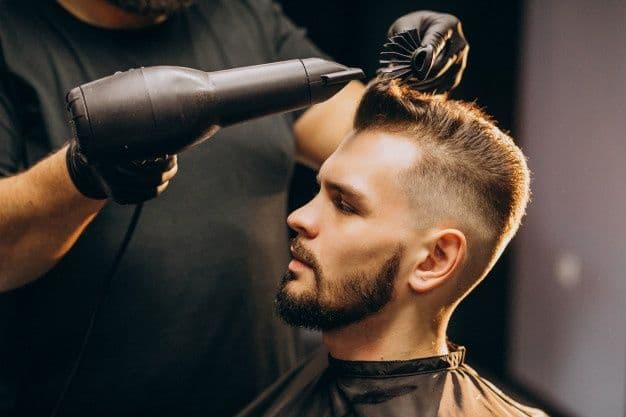
Oblong faces (also called "long faces" or "rectangular faces") are characterized by face length being significantly greater than width—typically a ratio of 1.7:1 or higher, compared to the ideal oval ratio of 1.5:1.
Key Characteristics of Oblong Faces
Extended Face Length
Face is noticeably longer than it is wide (1.7:1 or greater ratio)
Narrow Face Width
Cheekbones, forehead, and jawline are all relatively narrow
Straight Cheeklines
Face has parallel sides rather than curving (oval) or angular (square)
Long Forehead or Chin
Often accompanied by extended forehead height or longer chin
Self-Assessment Test
- Measure your face length from hairline to chin: ___ inches
- Measure width across cheekbones at widest point: ___ inches
- Calculate ratio: Length ÷ Width = ___
- If ratio is 1.7 or higher: You have an oblong face shape
- Visual check: Does your face look noticeably longer than it is wide?
- Mirror test: If you cover your hair, does your face look very long?
Oblong vs. Oval: What's the Difference?
Oval faces: Balanced 1.5:1 ratio, slightly curved sides, works with any haircut.
Oblong faces: Extended 1.7:1+ ratio, straighter sides, requires strategic haircuts to balance proportions.
Many oblong faces are simply "extended ovals" that need corrective styling.
The Oblong Face Challenge: Understanding Proportions
The Core Issue: Vertical Dominance
Oblong faces suffer from "vertical dominance"—the eye travels up and down rather than across, making the face appear narrow and elongated. The goal of strategic haircutting is to disrupt this vertical flow and create horizontal emphasis through width, texture, and careful fade placement.
Why Standard Haircuts Don't Work
High Fades Emphasize Length
Popular high fades (starting 2+ inches above ears) remove side volume and draw the eye upward, making oblong faces appear even longer and narrower. This is the opposite of what you need.
Volume on Top Adds Height
Pompadours, quiffs, and tall styles add 3-6 inches of vertical height, further elongating your face. While these look great on round or square faces, they're problematic for oblong proportions.
Slicked-Back Styles Expose Length
Slicking hair straight back reveals the full length of your face without any softening or width-adding elements. This creates an unbroken vertical line from forehead to chin.
The Strategic Solution
Add Width on Sides
Keep more hair on the sides (low fades, longer sides) to create the illusion of a wider face. Volume and texture on the sides counterbalance vertical length.
Minimize Height on Top
Keep top length moderate (2-3 inches max when styled). Avoid excessive volume that adds vertical height. Horizontal styling or forward movement works better than upward volume.
Create Horizontal Lines
Use horizontal elements like fringes, side-swept bangs, or textured layers that move across the face rather than up and down. This breaks vertical dominance.
Strategic Facial Hair
Beards add width at the bottom of the face and can shorten the appearance of the chin. This is a powerful tool for balancing oblong proportions.
Core Styling Principles for Oblong Faces
Golden rule: Every haircut decision should answer this question: "Does this add width or minimize length?" If the answer is neither (or worse, it adds length), choose a different style.
Principle #1: The 2-3 Inch Top Rule
Keep styled hair on top between 2-3 inches maximum. This provides enough texture and style without adding problematic vertical height.
✓ Ideal Top Lengths:
- • Textured crop: 1.5-2.5 inches
- • Caesar cut: 1-2 inches
- • Side part: 2-3 inches
- • French crop: 2-2.5 inches
✗ Problematic Heights:
- • Pompadour: 4-6 inches (too tall)
- • High quiff: 3-5 inches (adds length)
- • Faux hawk: 3-4 inches (vertical focus)
- • Mohawk: 4-8 inches (extremely elongating)
Principle #2: Maximize Side Volume
The sides of your haircut are your secret weapon. More hair = more width = better proportions.
Low fades (start just above ears)
Preserve maximum side volume while still looking clean and modern
Longer sides (1-2 inches)
Classic tapered styles maintain fullness that balances face length
Textured sides
Add movement and visual width through layering and texturizing
Principle #3: Embrace Horizontal Elements
Introduce horizontal lines that break up vertical length and guide the eye across rather than up-and-down:
- →Fringes/bangs: Cover forehead, shortening the apparent face length by 1-2 inches
- →Side-swept styling: Creates diagonal/horizontal movement instead of vertical lift
- →Textured layers: Piece-y, separated hair moves in multiple directions, disrupting vertical flow
- →Forward styling: Brush hair forward (not up or back) to add facial width
Principle #4: Strategic Part Placement
Where you place your part (or whether you have one) significantly impacts face shape perception:
✓ Beneficial Parts:
- • Deep side part (creates width asymmetry)
- • No part (textured, messy styles)
- • Diagonal part (horizontal emphasis)
⚠ Less Ideal Parts:
- • Center part (emphasizes symmetry, adds length)
- • Clean side part with slick styling (too vertical)
Real-World Application
At Therapeutic Cuts, oblong-faced clients usually get better results when the cut is planned around width, fringe direction, side weight, and beard shape instead of copying a popular high-fade or tall-volume style.
Best Fade Placements for Oblong Faces
Unlike oval faces that work with any fade, oblong faces have clear preferences. The lower the fade, the better.
Low Fade
Starts just above the ears. Preserves maximum side volume.
Mid Fade
Starts at temple level. Acceptable if kept longer on top sides.
High Fade
Starts 2+ inches above ears. Removes critical side volume.
Alternative to Fades: Classic Tapers
Traditional tapered cuts (where sides gradually shorten but maintain 1-2 inches of length) work excellently for oblong faces. These preserve even more side volume than low fades while still looking professional and clean.
Top 10 Haircuts for Oblong Face Men
Ranked by how well each cut adds side width, avoids extra height, and stays realistic for daily styling in Queens.
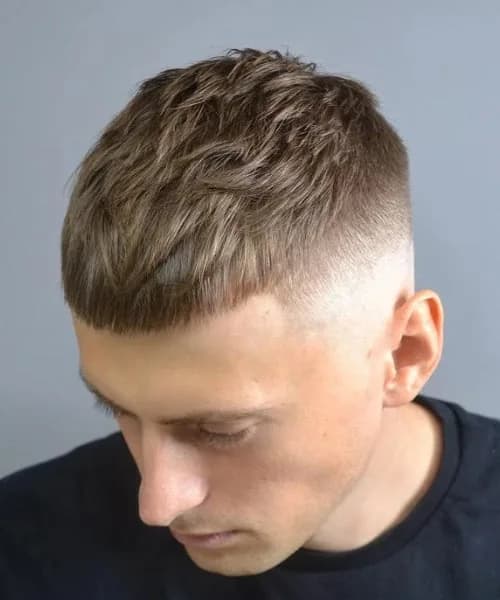
Textured Crop with Low Fade
The strongest oblong face haircut
Why it works for oblong faces:
- Forward-styled fringe softens forehead length.
- Low fade preserves side weight instead of narrowing the head.
- Moderate top length avoids adding extra height.
- Texture moves across the face, not straight upward.
Styling approach:
- Use a matte paste or clay on damp hair.
- Push the fringe forward and slightly to one side.
- Create piece-y separation with fingers.
- Keep the fringe near the eyebrows, not lifted high.
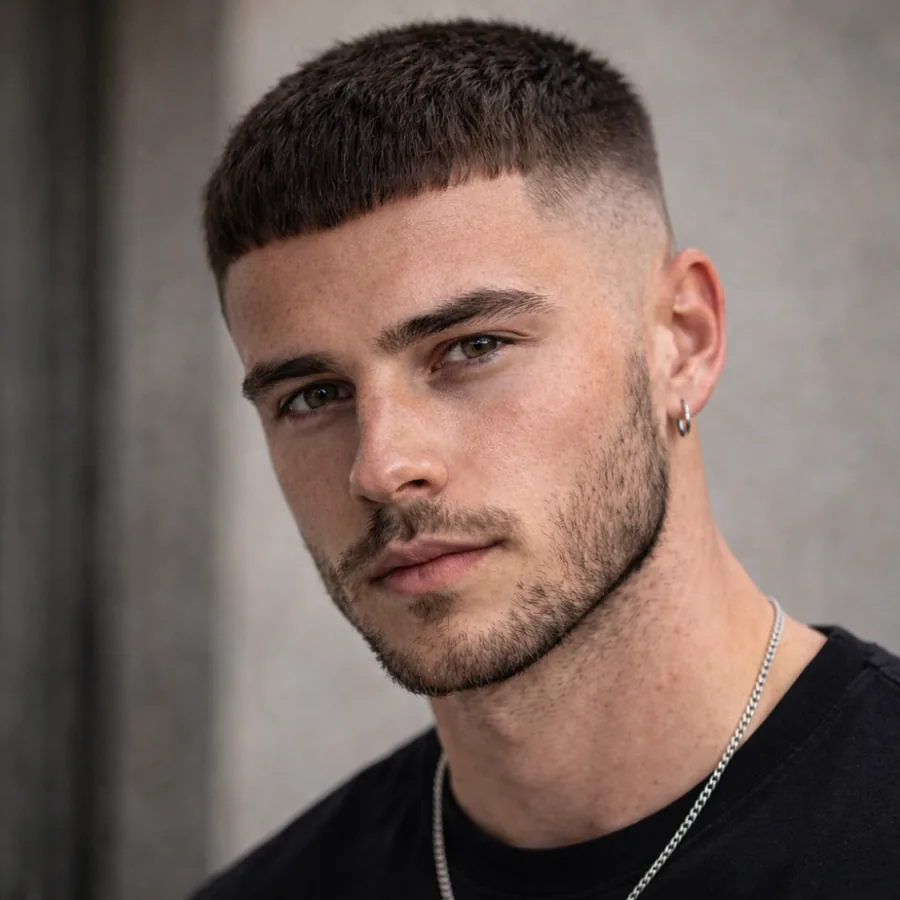
Caesar Cut with Short Sides
Classic horizontal fringe style
Why it works:
- Horizontal fringe creates width emphasis.
- Short, even length keeps the top from getting tall.
- Forehead coverage reduces the long-face effect.
- Simple shape is easy to keep consistent between visits.
Best for:
- Men who want low daily styling.
- Professional or school environments.
- Straight to slightly wavy hair.
- Clients who prefer a classic, controlled look.
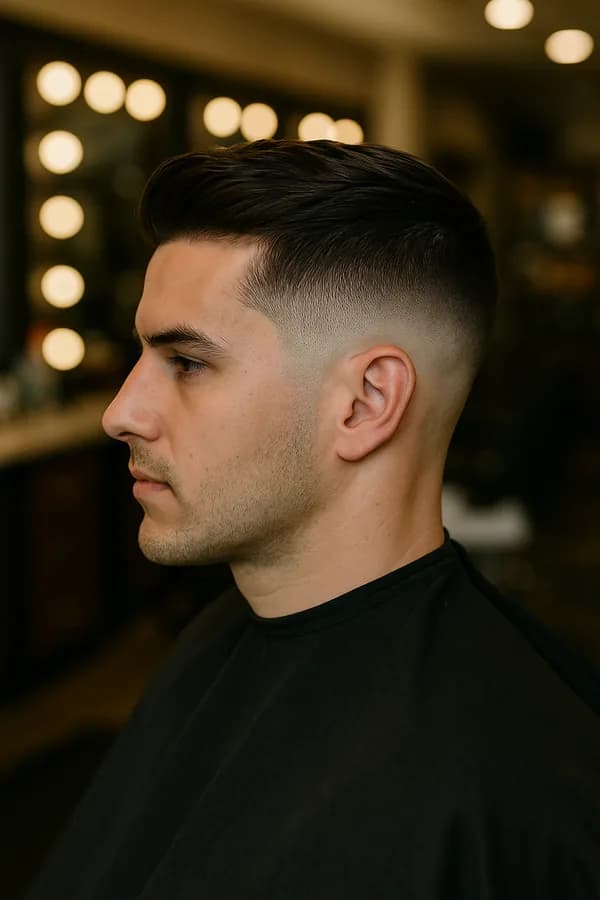
Deep Side Part with Tapered Sides
Professional with strategic volume
Strategic elements:
- A deep side part breaks up vertical symmetry.
- Tapered sides keep 1-2 inches of visual width.
- Top hair is directed across, not straight up.
- Works well for office and formal settings.
Styling requirements:
- Use a medium-hold pomade or cream.
- Comb the part cleanly while hair is damp.
- Keep side volume soft instead of flattened.
- Plan on 5-7 minutes of styling.
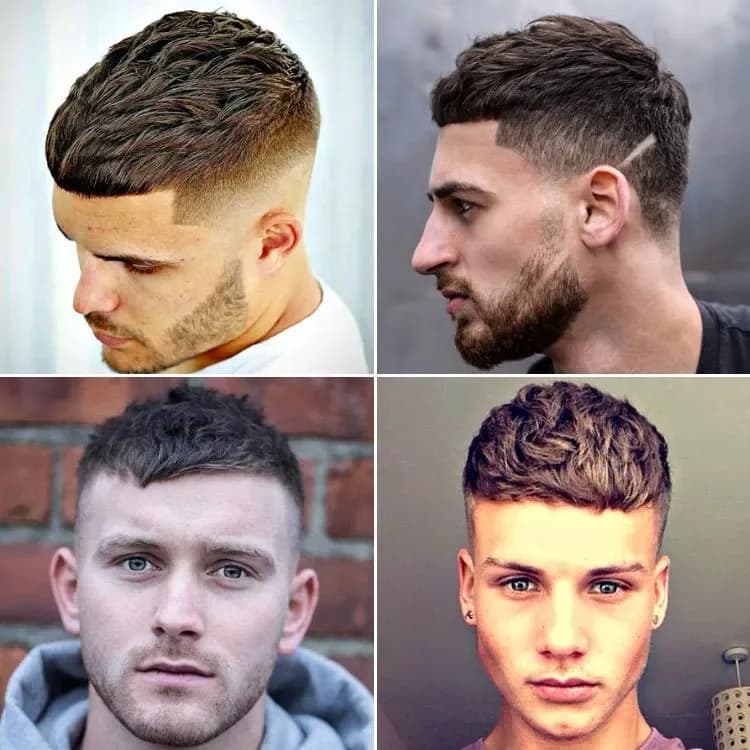
French Crop with Low Fade
Modern crop with fringe control
Why it works:
- Forward fringe shortens the apparent face length.
- Low fade keeps temple width in the haircut.
- Texture adds movement without building height.
- It looks current without becoming a tall quiff.
Ask for:
- A cropped top with textured ends.
- Low fade or soft taper, not a high skin fade.
- Fringe left long enough to sit forward.
- Matte product instead of shiny gel.
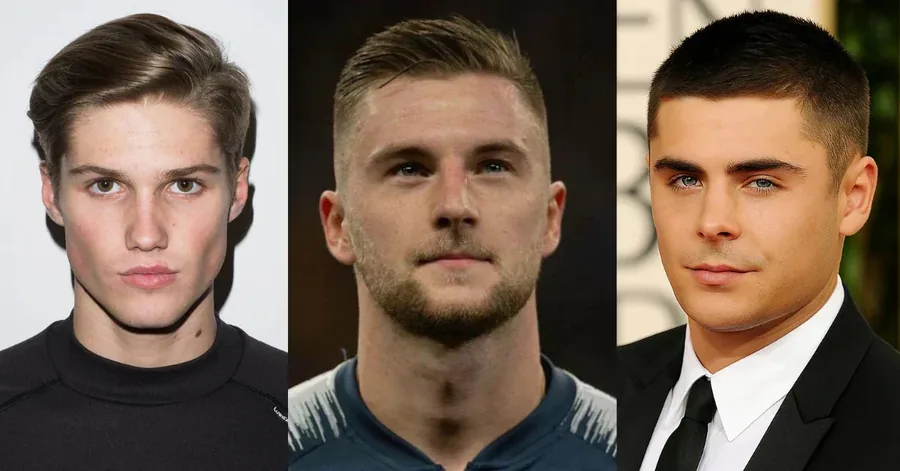
Ivy League Cut
Refined, collegiate classic
Why it works:
- Slightly longer top can be directed sideways.
- Tapered sides keep the outline balanced.
- It avoids the hard vertical lift of a quiff.
- Ages well from younger clients to older professionals.
Ask for:
- 2-3 inches on top with a soft side sweep.
- Scissor work or taper on the sides.
- Natural finish with light control.
- Enough front length to avoid exposing the whole forehead.
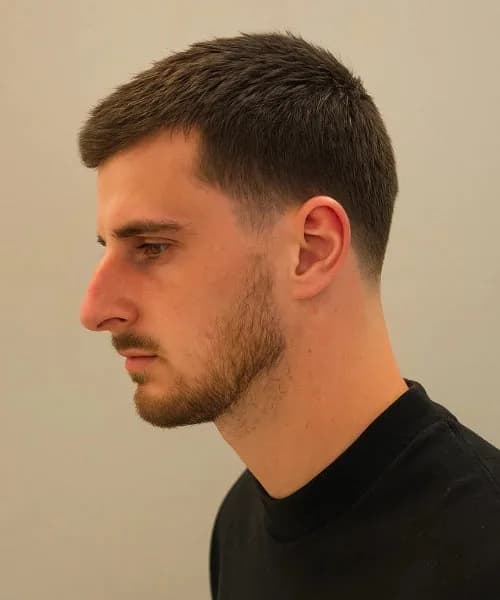
Crew Cut, Longer Variation
Short, clean, but not too severe
Why it works:
- Cleaner than medium styles without exposing the full skull shape.
- Longer sides protect width near the temples.
- Short top keeps daily styling simple.
- Good option for active routines.
Ask for:
- 1.5-2 inches on top.
- At least 1 inch through the sides before tapering.
- A soft front, not a spiky vertical top.
- No high skin fade if face length is the concern.
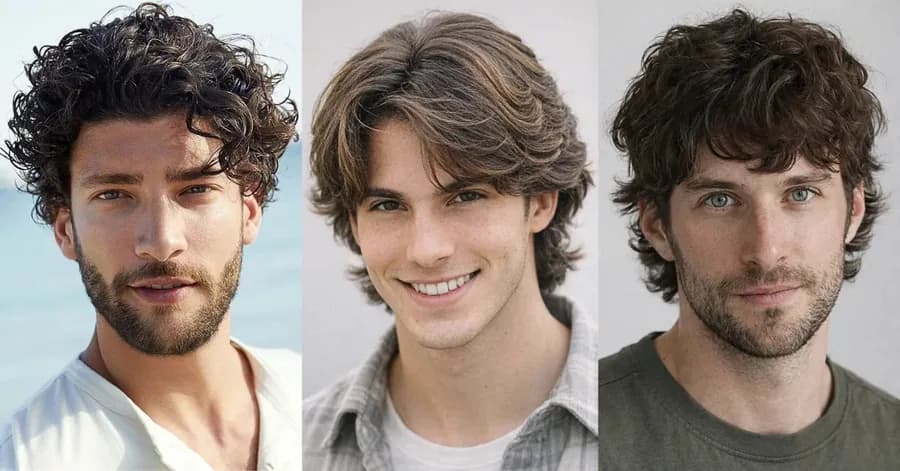
Messy/Textured Medium Length
Casual texture with horizontal movement
Why it works:
- Texture disrupts the straight up-and-down outline.
- Medium length lets hair move across the forehead.
- Fuller sides add width.
- Works well for casual and creative settings.
Ask for:
- 2-3 inches all around with heavy texturizing.
- A soft taper instead of a sharp high fade.
- Matte product and finger styling.
- Shape that falls forward or diagonally.
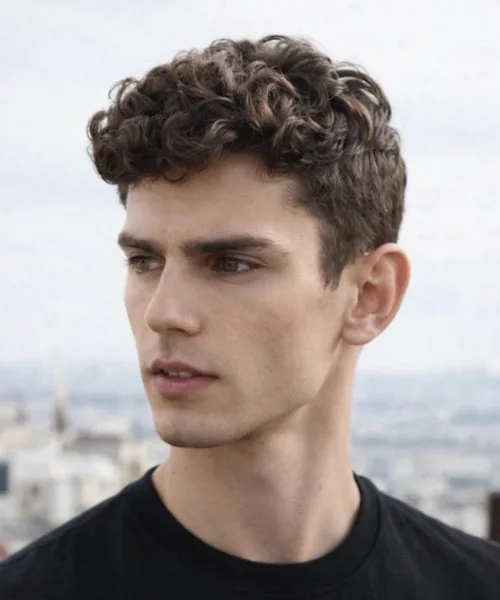
Curly/Wavy Top with Taper
Use natural texture for width
Why it works:
- Natural texture adds width without forcing height.
- A taper keeps the sides controlled but not bare.
- The shape can be pushed forward or diagonally.
- Good for clients whose hair already has body.
Ask for:
- Keep curls or waves soft on top.
- Leave fullness through the side corners.
- Use curl cream or sea salt spray.
- Avoid tall rounded volume at the crown.
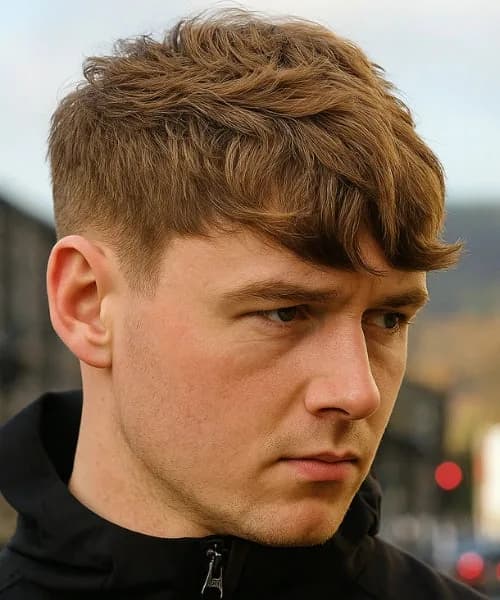
Short Side-Swept Style
Diagonal movement across the forehead
Why it works:
- Diagonal styling breaks the long vertical line.
- Some forehead coverage helps shorten the face visually.
- A taper keeps the sides from looking too narrow.
- Clean enough for everyday professional wear.
Ask for:
- 2-3 inches on top with a side sweep.
- Texture at the front, not a hard slick-back.
- Low taper around ears and neckline.
- Flexible hold so the style stays natural.
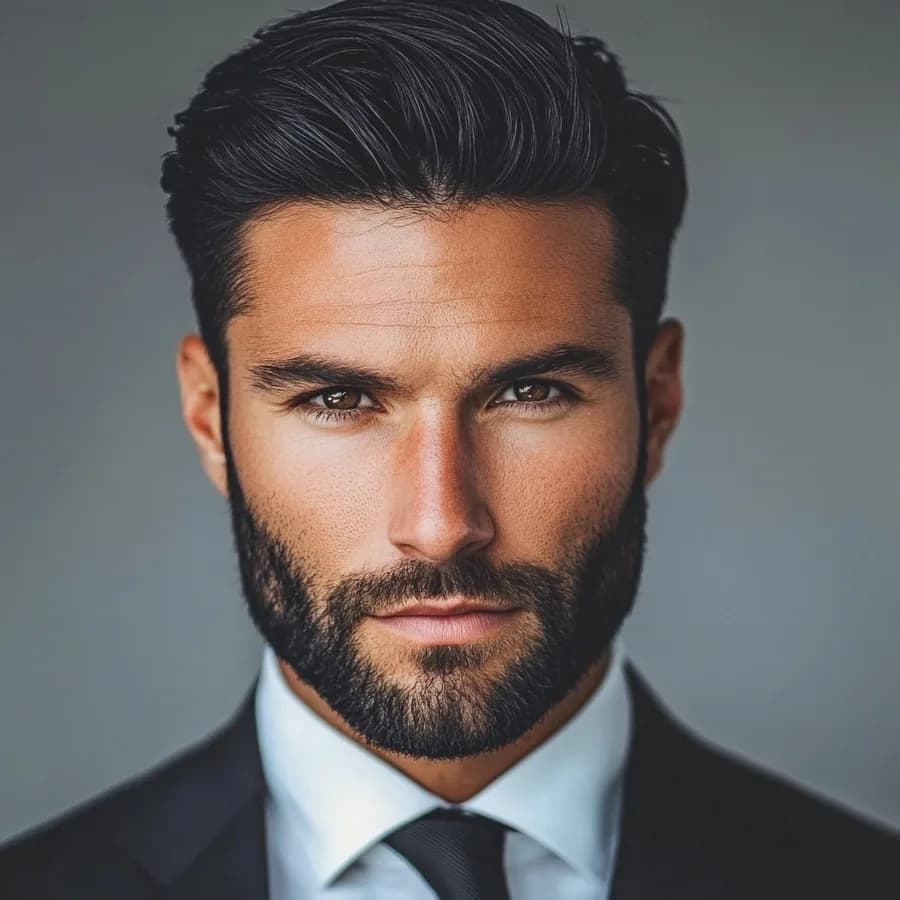
Businessman's Cut, Conservative Taper
Traditional shape with maximum professionalism
Why it works:
- Traditional taper keeps the sides present.
- The top can be styled across instead of upward.
- The outline looks polished without exaggerating length.
- Works for conservative workplaces and formal occasions.
Ask for:
- 1-2 inches on the sides and 2-3 inches on top.
- Scissor taper or low clipper taper.
- Natural side part, not a slick vertical comb-back.
- Beard or stubble shape if you want extra lower-face width.
Styles to Avoid (They'll Elongate Your Face)
Important: These aren't "bad" haircuts—they're just problematic for oblong face shapes. They'll make your face appear even longer and narrower, working against your goal of balanced proportions.
High Fades & Skin Fades
Why avoid: Removes too much side volume, creating dramatic vertical emphasis. The high contrast between shaved sides and longer top draws the eye straight up and down.
Impact: Can make a long face look even longer because the sides lose width and the top becomes the focal point.
Pompadours & High Quiffs
Why avoid: Adds 4-6 inches of vertical height on top of an already long face. Creates "lollipop" effect (large head on narrow face).
Impact: Exaggerates length dramatically. Works great on round faces, terrible on oblong faces.
Slicked-Back Styles (All Variations)
Why avoid: Exposes entire forehead and face length with no softening elements. Creates unbroken vertical line from hairline to chin.
Impact: Reveals full face length without any balancing width or horizontal elements.
Buzz Cuts & Very Short Styles
Why avoid: Removes all hair that could add width or shorten appearance. Reveals full skull and face shape without any softening.
Impact: Works for oval faces but emphasizes oblong proportions significantly.
Faux Hawks & Mohawks
Why avoid: Creates center ridge of vertical height while removing side volume. Double negative effect for oblong faces.
Impact: Combines worst elements: height on top + minimal sides = maximum elongation.
Center Parts with Long Hair
Why avoid: Center part creates perfect vertical symmetry, emphasizing length. Long hair adds additional visual length when worn down.
Impact: Creates continuous vertical line from crown to shoulders.
Man Buns & Top Knots
Why avoid: Pulls all hair up and back, exposing full face length. Adds vertical height with bun/knot placement.
Impact: Maximizes vertical emphasis while eliminating any width-adding elements.
"But I Really Want [Avoided Style]..."
If you're set on a typically-avoided style, consult with an experienced barber about modifications. For example: a "low pompadour" with 2-3" height (not 5-6") paired with a low fade might work. The key is adaptation, not strict prohibition.
Queens NYC Pricing & Value Guide
Oblong-Optimized Haircut Pricing
Annual Cost by Style
Therapeutic Cuts Rego Park - Oblong Face Specialists (2026)
Standard Services:
- • Haircut with face-shape consultation: $35-40
- • Haircut + Beard Trim (strategic for oblong): $45-50
- • Textured/Custom Cut: $40-45
- • Kids Cut (under 12): $25-30
Included Value:
- • Face shape analysis and recommendations
- • Hot towel treatment
- • Neck cleanup and detailing
- • Styling tips for your specific hair type
Facial Hair Strategies for Oblong Faces
Beards Are Your Secret Weapon
For oblong faces, a well-groomed beard is one of the most powerful tools for balancing proportions. Beards add width at the bottom of the face and can visually "shorten" the chin area by 1-2 inches. This is highly recommended if you can grow facial hair.
Best Beard Styles for Oblong Faces
Full Beard (Short to Medium)
0.5-1.5 inches. Adds maximum width to lower face. Keep it wider on sides, shorter on chin to avoid adding length.
Boxed Beard (Squared Bottom)
Square-shaped bottom creates horizontal line. Ideal for professional contexts. Adds width without length.
Mutton Chops / Sideburns
Extends hair down sides of face, adding critical width exactly where needed. Bold, distinctive look.
Heavy Stubble (5-7 Days)
Low maintenance option that adds subtle width and definition without full beard commitment.
Beard Styles to Avoid
Long, Pointed Beards
Adds vertical length at chin. Creates even longer appearance. Classic "wizard beard" effect is problematic.
Chin Strap / Jaw Strap Only
Outlines the face without adding width. Emphasizes jaw length. Creates vertical emphasis.
Soul Patch / Landing Strip
Small patch below lip adds tiny vertical element. No width benefit. Draws attention to center/length.
Clean Shaven
While not "bad," you're missing opportunity to add balance. Consider at least stubble for width.
Optimal Beard + Haircut Combinations
Maximum Balance Combinations:
- • Textured crop + Full beard = Excellent balance
- • Caesar cut + Boxed beard = Professional + balanced
- • French crop + Medium beard = Modern + proportionate
- • Side part + Corporate beard = Executive presence
Maintenance Schedule:
- • Trim beard every 1-2 weeks to maintain shape
- • Coordinate beard trim with haircut appointments
- • Keep beard width full, length moderate
- • Professional shaping every 3-4 weeks recommended
Maintenance & Styling Tips
Daily Styling Routine
- Start with damp hair
Towel-dry after shower. Hair should be damp, not dripping.
- Apply product
Texturizing paste, clay, or light pomade. Dime to nickel-sized amount.
- Style forward or to side
Never straight up. Create horizontal movement with fingers.
- Check side volume
Ensure sides aren't flattened. Maintain fullness for width.
- Fringe placement (if applicable)
Keep fringe at or near eyebrows to cover forehead effectively.
Recommended Products
Texturizing Paste/Clay
Best for: Textured crops, French crops, messy styles. Provides hold with matte finish and piece-y texture.
Light-Medium Pomade
Best for: Side parts, Ivy League, classic styles. Adds shine and control without excessive weight.
Sea Salt Spray
Best for: Wavy/curly hair, textured medium length. Enhances natural texture and adds volume.
Avoid: Strong Hold Gels
Can create stiff, vertical styles. Look for flexible hold products instead.
Haircut Frequency by Style
| Style | Frequency | Why This Timing |
|---|---|---|
| Textured Crop | 3-4 weeks | Maintain fringe length and side balance |
| Caesar Cut | 4-5 weeks | Keep horizontal fringe line clean |
| Side Part/Taper | 4-6 weeks | Longer sides grow out gracefully |
| French Crop | 3-4 weeks | Texture and shape maintenance |
| Ivy League | 4-5 weeks | Classic cut ages well between visits |
Frequently Asked Questions
What is the best haircut for an oblong face?
The best haircuts for oblong faces add width and minimize vertical length. Top choices include: textured crops with volume on sides (creates width), side parts with full sides (balances proportions), Caesar cuts with horizontal fringe (shortens appearance), and low to mid fades (avoid high fades that elongate). The goal is to create the illusion of a shorter, wider face through strategic styling and fade placement.
Should oblong face men avoid high fades?
Yes, high fades are generally not recommended for oblong faces. High fades start 2+ inches above the ears and draw the eye upward, emphasizing vertical length and making the face appear even longer. Instead, oblong faces should opt for low fades (just above ears) or mid fades (at temple level) that maintain more hair on the sides, creating the illusion of width and balanced proportions.
Can men with oblong faces wear pompadours?
Pompadours are not ideal for oblong faces because they add significant vertical height, further elongating an already long face. However, if you love the pompadour aesthetic, opt for a 'low pompadour' with 2-3 inches of height (not 4-6 inches) and pair with a low fade to maintain side volume. Keep the height moderate and consider adding fullness on the sides to balance proportions.
What fade is best for oblong face?
Low fades and mid fades work best for oblong faces. Low fades (starting just above the ears) preserve maximum side volume and create width. Mid fades (starting at temple level) offer a modern look while still maintaining enough hair on sides to balance proportions. Avoid high fades and skin fades on the sides, as these emphasize vertical length and make the face appear narrower and longer.
How much do oblong face haircuts cost in Queens NYC?
Haircuts for oblong face men in Queens typically cost $35-45 depending on complexity. Simple styles (Caesar cuts, crew cuts): $30-35. Strategic fades with texture (textured crops, side parts): $35-40. Advanced cuts requiring precision (layered styles, custom fades): $40-50. At Therapeutic Cuts in Rego Park, most oblong-optimized haircuts are $35-40 with face-shape consultation included.
Should oblong faces have beards?
Yes, beards are highly recommended for oblong faces. A well-groomed beard adds width to the lower face and can visually shorten the chin area by 1-2 inches, significantly improving facial proportions. Opt for full beards, boxed beards, or heavy stubble. Avoid long pointed beards or chin straps that add vertical length. Combine your beard with an oblong-optimized haircut for maximum balance.
Can oblong face men wear buzz cuts?
Buzz cuts are not recommended for oblong faces. Ultra-short hair removes all elements that could add width or reduce apparent length, revealing the full extent of the oblong face shape. If you prefer very short hair for practical reasons, consider a longer crew cut (1.5-2 inches on top) with tapered sides that maintain some volume, or compensate with a full beard to add lower-face width.
How can I make my oblong face look shorter?
To make an oblong face appear shorter: (1) Get haircuts with forward or side-swept fringes that cover 1-2 inches of forehead, (2) Choose low fades or tapered sides that preserve width, (3) Keep top length moderate (2-3 inches maximum when styled), (4) Style hair horizontally (across) rather than vertically (up), (5) Grow a beard to add width at bottom of face, and (6) Avoid high fades, pompadours, and slicked-back styles that emphasize length.
Ready to Balance Your Oblong Face Proportions?
Visit Therapeutic Cuts in Rego Park, Queens for expert face-shape consultation. Our experienced barbers specialize in strategic cuts that add width, minimize length, and create balanced, proportionate results for oblong faces.
Location
63-53 Alderton St
Rego Park, NY 11374
Hours
Mon-Wed: 9am-7pm
Thu: 9am-9pm
Fri: 9am-5pm
Sun: 9am-5pm
Walk-ins Welcome
Face-shape specialists
Professional consultation included
Related Haircut Guides
Haircuts for Oval Faces
The versatile face shape that works with virtually any haircut style.
Read guide →Haircuts for Round Faces
Strategic styles to add vertical length and slim round face proportions.
Read guide →Low Fade Complete Guide
The ideal fade placement for oblong faces—maintains side volume perfectly.
Read guide →