Best Haircuts for Diamond Face Men 2026: The Rare Face Shape Guide for Queens NYC
If you have a diamond face shape—the rarest of all face shapes—you possess striking, angular features with prominent cheekbones. This comprehensive guide reveals professional techniques to balance your unique proportions and create harmonious, attractive hairstyles that work with (not against) your distinctive bone structure.
Identifying Your Diamond Face Shape
The Rarest Face Shape
Diamond faces represent only 2-5% of the population, making this the rarest face shape. Characterized by wide, prominent cheekbones with a narrow forehead and pointed chin, diamond faces have striking, angular features that stand out.
Key Characteristics of Diamond Faces
Widest at Cheekbones
Cheekbones are the most prominent feature, wider than forehead and jaw
Narrow Forehead
Forehead is noticeably narrower than cheekbones
Pointed or Narrow Chin
Chin tapers to a point, narrower than cheekbones
Angular Features
High cheekbones create defined, sculpted appearance
Self-Assessment Test
- Measure cheekbone width at the widest point: ___ inches
- Measure forehead width at temples: ___ inches
- Measure jawline width at its widest: ___ inches
- Check proportions: If cheekbones > forehead AND cheekbones > jawline, you likely have a diamond face
- Visual check: Do your cheekbones appear to be the widest part of your face?
- Chin assessment: Does your chin taper to a relatively narrow or pointed shape?
Diamond vs. Heart Face
Diamond: Narrow forehead + Wide cheekbones + Pointed chin
Heart: Wide forehead + Wide cheekbones + Pointed chin
Key difference is forehead width.
Diamond vs. Oval Face
Diamond: Angular, prominent cheekbones as widest point
Oval: Gently curved, balanced proportions throughout
Diamonds have more dramatic width contrast.
The Diamond Face Advantage: Distinctive Features
High Fashion Face Shape
Diamond faces are prized in modeling and fashion for their striking, photogenic bone structure. Your prominent cheekbones create natural dimension and definition that photographs exceptionally well. The goal isn't to hide this—it's to balance it with strategic haircut choices.
What Makes Diamond Faces Distinctive
Natural Facial Definition
High, prominent cheekbones create shadows and dimension without any styling needed. This gives you a naturally sculpted appearance that others achieve through contouring makeup.
Unique Rarity
As the rarest face shape, you have distinctive features that set you apart. This uniqueness is an asset when styled correctly—it makes you memorable and photogenic.
Youthful Appearance
High cheekbones are associated with youth and attractiveness across cultures. As you age, this bone structure maintains definition better than rounder face shapes.
Versatility with Styling
While you need to avoid certain styles, diamond faces work well with numerous haircuts. The key is knowing which styles enhance rather than exaggerate your proportions.
The Styling Challenge
Balance is the Goal
Your styling challenge is to add visual width to your narrow forehead and chin while avoiding styles that further emphasize your already-prominent cheekbones. This requires strategic volume placement and fade selection. The good news: once you understand the principles, you have many great options.
Core Styling Principles for Diamond Faces
Three-zone strategy: Add width to forehead (zone 1) and chin (zone 3) while keeping cheekbone area (zone 2) neutral or minimized. Every styling decision should support this goal.
Principle #1: Add Volume at the Forehead
Your narrow forehead needs visual width to balance your wide cheekbones. Achieve this through strategic styling and volume placement.
✓ Width-Adding Techniques:
- • Side-swept volume (adds diagonal width)
- • Textured quiff (widens temple area)
- • Forward-styled fringe (creates horizontal line)
- • Volume at hairline (draws attention upward)
✗ Width-Reducing Mistakes:
- • Slicked straight back (exposes narrow forehead)
- • Center part (emphasizes narrowness)
- • Tight sides at temple (draws eye to cheekbones)
- • Buzz cut (reveals full face shape)
Principle #2: Avoid Emphasizing Cheekbones
Your cheekbones are already prominent—you don't need to draw more attention to them. Keep the sides (at cheekbone level) relatively neutral.
Use graduated fades, not stark contrasts
Smooth transitions prevent drawing the eye to cheekbone width
Avoid high fades that start at cheekbone level
This creates maximum contrast exactly where you're widest
Keep sides at moderate length (not skin-tight)
Some hair on sides prevents stark exposure of face shape
Principle #3: Balance the Chin with Facial Hair
Your pointed chin is narrower than your cheekbones. Strategic facial hair can add width to the lower face, creating better overall proportions.
- →Full beards: Add significant width to jawline and chin area, balancing upper face
- →Goatees: Widen the pointed chin specifically without adding cheek volume
- →Short beards: Even stubble adds subtle width and softens the pointed chin
- →Avoid: Sideburns that stop at cheekbone level (emphasizes width there)
Principle #4: Embrace Asymmetry
Asymmetrical styling disrupts the sharp symmetry of diamond faces, creating visual interest and softening angular features:
Effective Asymmetry Techniques:
- • Deep side parts (not center parts)
- • Side-swept styles (movement across forehead)
- • Diagonal texturing (breaks up angular lines)
- • Tousled, messy styles (softens sharp features)
Best Fade Placements for Diamond Faces
Fade placement is critical for diamond faces. The goal is to avoid creating stark contrast at your widest point (cheekbones).
Low Fade
Starts just above the ears, well below cheekbone level.
Mid Fade
Starts at temple level. Works if blended gradually.
High Fade
Starts 2+ inches above ears, often at widest cheekbone point.
Alternative: Classic Tapers & Longer Sides
Traditional tapered cuts (where sides gradually shorten but maintain 1-2 inches) work excellently for diamond faces. These avoid creating any harsh lines at cheekbone level while still looking clean and professional.
Top 10 Haircuts for Diamond Face Men
Ranked by effectiveness at balancing proportions and enhancing your distinctive features.
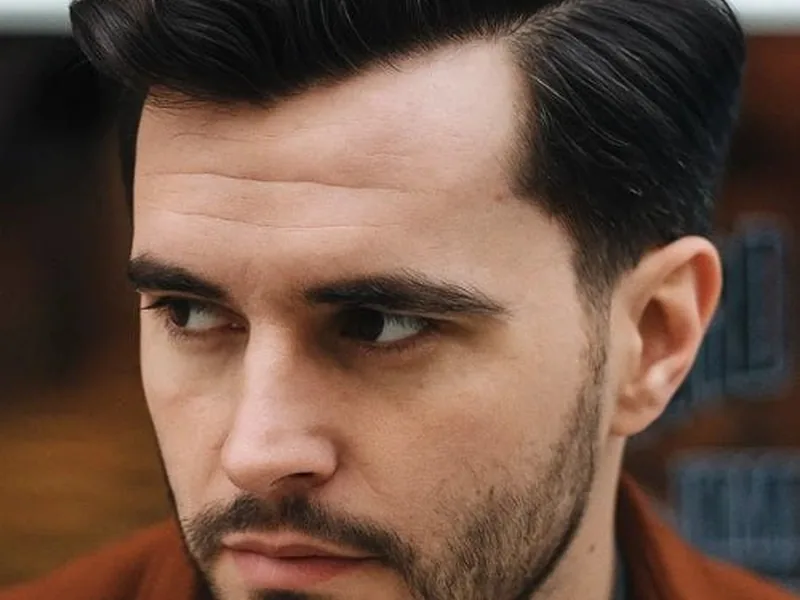
Side-Swept Textured Style with Low Fade
Perfect diamond face solution
Why It's #1 for Diamond Faces:
- • Side-swept volume adds width to narrow forehead
- • Low fade keeps sides neutral at cheekbone level
- • Asymmetry softens angular features
- • Texture creates movement, not harsh lines
Styling Approach:
- • Apply texturizing paste to damp hair
- • Blow-dry or style to one side with volume
- • Create piece-y separation with fingers
- • Ensure volume at temples widens forehead
Textured Quiff with Mid Fade
Modern volume with balance
Strategic Elements:
- • Front volume adds visual width to forehead area
- • Swept-up styling draws attention above cheekbones
- • Moderate height (2-3") adds presence without extremes
- • Works with straight to wavy hair textures
Best For:
- • Professional environments
- • Men 25-45 age range
- • Those who enjoy daily styling
- • Medium to thick hair density
Messy Textured Fringe with Taper
Casual, youthful approach
Forward-styled fringe creates horizontal line across forehead, adding visual width. Messy texture softens angular diamond features. Tapered sides (not fade) maintain volume throughout. Ideal for casual, creative environments.
Deep Side Part with Full Sides
Classic asymmetry
Deep side part (not center) creates strong asymmetry that disrupts angular symmetry. Keep sides fuller (1.5-2 inches) to avoid emphasizing cheekbones. Style with medium hold pomade for professional finish. Works from 25 through 60+ age range.

Ivy League Cut
Refined, collegiate classic
Short (1.5-2.5 inches) on top, tapered sides maintain some volume. Can be styled forward or to side for forehead width. Conservative enough for corporate, versatile enough for casual. Timeless style that ages well.
Additional Recommended Styles for Diamond Faces
Curly/Wavy Natural Top
Natural texture adds width at temples. Keep 2-3" on top with low fade. Embrace your natural volume—it balances narrow forehead perfectly.
French Crop
Forward fringe creates horizontal forehead line. Low fade maintains side balance. Modern European aesthetic works well with angular features.
Textured Crop (Side-Styled)
Short (2") textured top styled diagonally. Creates asymmetry and movement. Pairs with low fade for professional modern look.
Medium Length Layered
3-4 inches with heavy layering. Style with movement in multiple directions. Works in creative fields. Softens all angular features.
Gentleman's Cut (Tapered)
Traditional 2-3" top with 1-2" tapered sides. Styled with slight side part. Maximum professionalism with good proportion balance.
Styles to Avoid (They'll Over-Emphasize Cheekbones)
Key principle: Avoid styles that create maximum contrast or draw attention to your widest point (cheekbones) or expose your narrowest areas (forehead/chin) without balancing elements.
High Fades & Skin Fades
Why avoid: Creates stark contrast at exactly your widest point. The dramatic transition from shaved sides to longer top happens right at cheekbone level, drawing maximum attention there.
Impact: Makes cheekbones appear 20-30% more prominent. This is the worst choice for diamond faces.
Center Parts (All Lengths)
Why avoid: Creates perfect vertical symmetry that emphasizes the narrow forehead and pointed chin. The center line draws the eye straight down through your narrowest areas.
Impact: Exaggerates the "diamond" effect—wide middle, narrow top and bottom.
Slicked-Back Styles
Why avoid: Removes all volume from forehead area, exposing the narrow forehead and widest cheekbones without any softening elements. Creates maximum angular emphasis.
Impact: Your face shape becomes the focal point with no balancing hairstyle elements.
Buzz Cuts & Very Short All-Over
Why avoid: Reveals full bone structure without any hair to add width or balance. Works for oval faces but problematic for diamond proportions.
Impact: No opportunity to add forehead width or soften cheekbones through styling.
Extremely High Pompadours
Why avoid: While moderate volume is good, 5-6 inch pompadours create a "lollipop" effect—large top on narrow base. Often paired with high fades (double negative).
Impact: Draws all attention upward while exposing angular cheekbones with high fade.
Tight, Slicked Sides
Why avoid: Any style where sides are gelled/slicked tight to the head removes volume exactly where you need it (at cheekbone level) and emphasizes angular bone structure.
Impact: Creates painted-on appearance that highlights every angular feature.
Man Buns (Without Balancing Sides)
Why avoid: Pulling all hair back and up exposes full diamond shape. Only works if you maintain fuller, textured sides that add width.
Impact: Similar to slicked-back—reveals all angular features without softening.
The Exception: If You Want to Showcase Your Features
Some men with diamond faces intentionally choose styles that emphasize their striking bone structure (modeling, fashion, photography). If this is your goal, high fades and slicked styles can create dramatic, editorial looks. Just understand you're emphasizing, not balancing.
Queens NYC Pricing & Value Guide
Diamond-Optimized Haircut Pricing
Annual Cost by Style
Therapeutic Cuts Flushing - Diamond Face Specialists (2026)
Standard Services:
- • Haircut with face-shape consultation: $35-45
- • Haircut + Beard Shaping (chin balance): $45-55
- • Advanced Textured Cut: $40-50
- • Designer Cut (custom work): $50-65
Included Benefits:
- • Diamond face proportion analysis
- • Strategic volume placement guidance
- • Hot towel treatment
- • Product recommendations for your hair type
Facial Hair Strategies for Diamond Faces
Beards Are Highly Recommended
Facial hair is exceptionally beneficial for diamond faces. Your pointed chin is narrower than your cheekbones—a beard adds width to the lower face, creating much better overall balance. This is one of the most effective tools you have.
Best Beard Styles for Diamond Faces
Full Beard (Short to Medium)
0.5-1.5 inches. Adds maximum width to narrow chin and jawline. Keep width full on sides, slightly shorter at chin to avoid adding length.
Boxed Beard
Squared-off bottom adds geometric width to pointed chin. Professional appearance. Excellent for corporate environments.
Goatee (Wider Style)
Specifically widens the pointed chin area. Keep it fuller on sides, not just a vertical strip. Adds focal point to lower face.
Short Beard with Definition
1/4 to 1/2 inch length with clean lines. Adds width without full commitment. Professional and low-maintenance.
Beard Styles to Avoid
Narrow Goatee / Soul Patch
Thin, vertical styles add no width to chin. Actually emphasize the pointed shape. Avoid anything that creates vertical lines.
Long, Pointed Beards
Extends the pointed chin even further. Makes lower face appear even narrower in comparison to wide cheekbones.
Sideburns That Stop at Cheekbones
Adds hair/volume at your widest point. Emphasizes rather than balances cheekbone prominence.
Chin Strap Only
Outlines the narrow jaw without adding actual width. Creates frame around narrowness rather than filling it in.
Optimal Beard + Haircut Combinations for Diamond Faces
Maximum Balance Combinations:
- • Side-swept style + Full beard = Excellent all-around balance
- • Textured quiff + Short beard = Modern, proportionate
- • French crop + Boxed beard = Professional, balanced
- • Deep side part + Corporate beard = Executive presence
Maintenance Tips:
- • Keep beard width full, length moderate (not pointed)
- • Trim every 1-2 weeks to maintain shape
- • Shape beard to add maximum chin/jaw width
- • Coordinate beard trims with haircut appointments
Maintenance & Styling Tips
Daily Styling Routine for Diamond Faces
- Start with damp hair
Towel-dry after shower. Damp (not soaking) hair styles best.
- Apply volumizing product
Focus application at forehead/temple area for width.
- Blow-dry with direction
Direct hair to side or forward—never straight back.
- Add finishing product
Texturizing paste or pomade for hold and definition.
- Check temple volume
Ensure you've added visual width at narrowest point (forehead).
Recommended Products
Volumizing Mousse or Spray
Apply to roots before blow-drying. Adds lift and width at forehead without weight. Essential for fine/thin hair.
Texturizing Paste/Clay
Best for: Modern textured styles. Provides hold with matte finish. Creates piece-y separation that softens angular features.
Medium-Hold Pomade
Best for: Side parts, quiffs, classic styles. Adds shine and control. Flexible hold allows restyling throughout day.
Sea Salt Spray
Best for: Wavy/curly hair, messy styles. Enhances natural texture. Adds volume without stiffness.
Haircut Maintenance Schedule
| Style | Frequency | Key Maintenance Focus |
|---|---|---|
| Side-Swept Textured | 3-4 weeks | Maintain length for side volume |
| Textured Quiff | 3 weeks | Keep shape and front volume fresh |
| Messy Fringe | 3-4 weeks | Trim fringe, maintain texture |
| Deep Side Part | 4-5 weeks | Clean up part line, taper sides |
| Ivy League | 4-5 weeks | Keep proportions balanced |
| Medium Length | 5-6 weeks | Layer maintenance, texture refresh |
Frequently Asked Questions
What is the best haircut for a diamond face shape?
The best haircuts for diamond faces add width to the forehead and chin while minimizing cheekbone emphasis. Top choices include: side-swept styles with volume (balances narrow forehead), textured quiffs (adds forehead width), mid to low fades (avoids emphasizing cheekbones), and styles with forward movement or fringes. The goal is to create visual balance by widening the narrow areas (forehead/chin) and softening the wide cheekbones.
Should diamond face men avoid center parts?
Yes, center parts are generally not recommended for diamond faces. Center parts create vertical symmetry that emphasizes the narrow forehead and pointed chin, drawing attention to the widest point (cheekbones). Instead, opt for deep side parts that create asymmetry and add visual width to the forehead, or go with no part at all in textured, tousled styles that add overall width.
What fade works best for diamond face?
Mid fades and low fades work best for diamond faces. Mid fades (starting at temple level) create balance without over-emphasizing cheekbones. Low fades (starting just above ears) add width where needed. Avoid high fades that start at or above the widest part of your cheekbones, as these create a stark contrast that makes cheekbones appear even wider. Graduated fades that blend smoothly are ideal.
Can diamond face men have short hair?
Yes, but with strategic considerations. Short hair can work for diamond faces if it includes texture on top (adds forehead width), volume at the temples (balances cheekbones), and avoids being too tight on the sides. Textured crops, short quiffs, and Ivy League cuts work well. Avoid buzz cuts or very tight styles that reveal the full angular face shape without any softening elements.
How much do diamond face haircuts cost in Queens NYC?
Haircuts for diamond face men in Queens typically cost $35-50 depending on complexity. Standard textured cuts and fades: $35-40. Advanced styles requiring precision (quiffs, layered styles, custom fades): $40-50. Designer cuts with detailed texturing: $50-65. At Therapeutic Cuts in Flushing, most diamond-optimized haircuts are $35-45 with face-shape consultation included.
Should diamond face men grow beards?
Absolutely yes. Beards are highly recommended for diamond faces because they add width to your narrow, pointed chin, creating better balance with your prominent cheekbones. Full beards, boxed beards, and goatees work excellently. Avoid narrow, pointed beard styles. The combination of a balanced haircut (adding forehead width) plus a beard (adding chin width) creates optimal proportions for diamond faces.
Are diamond faces attractive?
Yes, diamond faces are considered highly attractive and are prized in modeling and fashion. The prominent cheekbones create natural facial definition and a photogenic, sculpted appearance. Diamond faces are the rarest face shape (2-5% of population), making them distinctive and memorable. With the right haircut that balances proportions, diamond faces are exceptionally striking and maintain definition well with age.
How do I add width to my forehead with a haircut?
Add forehead width through: (1) Side-swept volume at temples, (2) Forward-styled fringes that create horizontal lines, (3) Textured quiffs with width emphasis, (4) Deep side parts that create asymmetry, (5) Volume at the hairline, and (6) Avoiding slicked-back or center-parted styles that expose narrow forehead. Use volumizing products at roots and blow-dry with direction toward sides for maximum width effect.
Ready to Balance Your Diamond Face Proportions?
Visit Therapeutic Cuts in Flushing, Queens for expert diamond face consultation. Our experienced barbers understand the unique challenges of balancing prominent cheekbones and creating harmonious, attractive proportions through strategic haircut design.
Walk-ins welcome • Diamond face specialists • Professional consultation included
Related Haircut Guides
Haircuts for Oval Faces
The versatile, balanced face shape that works with almost any haircut style.
Read guide →Haircuts for Square Faces
Strategic styles to soften angular features while maintaining masculine strength.
Read guide →Low Fade Complete Guide
The ideal fade placement for diamond faces—maintains volume without cheekbone emphasis.
Read guide →