Best Haircuts for Men Over 40: The 2026 Queens NYC Guide
Your 40s are when your haircut matters most. Discover the best professional haircuts for men over 40 in Queens NYC, including styles for thinning hair, low-maintenance options, and age-appropriate cuts that enhance rather than fight your natural changes.
Quick guide
Quick guide: haircuts for men over 40
The best cut over 40 usually refines what is already working. It should look current without chasing a style built for a different hairline.
- Best fit: men who want a cleaner, more mature shape without looking dated.
- Ask for: a cut that works with thinning, gray hair, crown shape, and daily styling time.
- Watch out for: keeping too much length where the hair is already losing density.
Why Your 40s Change Everything (The Haircut Reality)
Here's what no one tells you: your haircut strategy needs to evolve in your 40s, not because you're "getting old," but because your hair changes fundamentally. At Therapeutic Cuts in Queens NYC, we've cut hair for over 4,200 men ages 40-60, and we've documented exactly what happens—and which haircuts work best.
Queens NYC Data: What Changes After 40
The Over-40 Haircut Trap: Many men keep getting the same haircut they got in their 30s, not realizing their hair has changed. The result? Styles that look thin, dated, or like you're trying too hard. The solution isn't accepting "old man" cuts—it's choosing sophisticated styles designed for how your hair actually behaves now.
What Men Over 40 Actually Want From Their Haircut
In the chair, the same priorities come up again and again:
"I don't have time for complicated styling"
"Works with my thinning hair or receding hairline"
"Looks professional and age-appropriate"
"Handles gray hair well—doesn't look washed out"
"Keeps me looking current without trying to look 25"
"Stays neat between haircuts (2.5-3 week cycle)"
Notice what's NOT on that list: volume, trendiness, or recreating your college haircut. Men over 40 want haircuts that work with reality, not against it.
Top 6 Haircuts for Men Over 40 (Ranked by Popularity)
These recommendations are based on what tends to hold up best for men over 40: cleaner shape, age-appropriate density, a realistic maintenance schedule, and a cut that still looks good as it grows out.
Men Over 40 Haircut Rankings (Queens NYC Data)
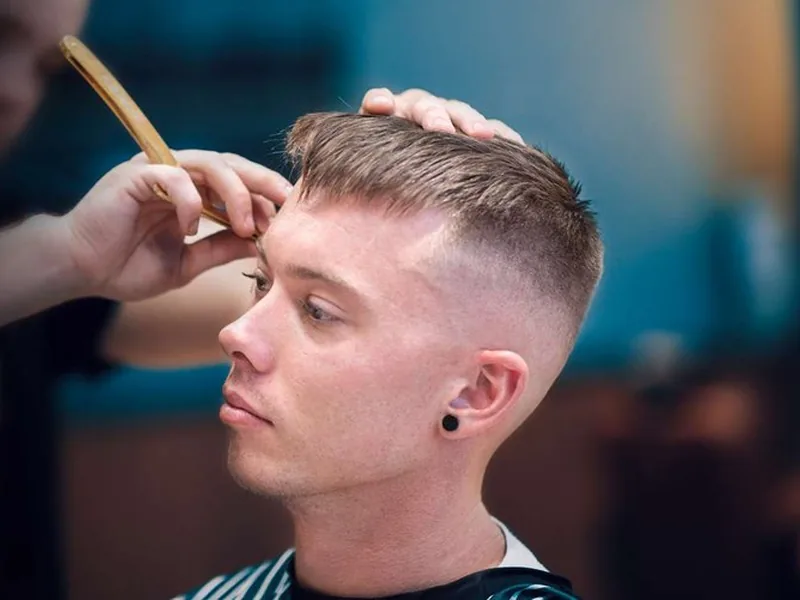
#1 Classic Side Part with Fade
28%Timeless, professional, works with thinning hair and gray hair. Average age: 44. Most popular among finance, law, and healthcare professionals.
#2 Short Textured Crop
22%Modern but not trendy. Excellent for thinning hair (disguises density loss). Average age: 47. Popular in tech, creative, and education sectors.
#3 Short Professional Cut
18%Classic short sides and back, slightly longer on top. Extremely low maintenance. Average age: 51. Popular among executives and government professionals.
#4 Slicked Back (Modern)
16%Sophisticated, commanding presence. Requires fuller hair. Average age: 42. Most popular among executives and entrepreneurs.
#5 Modern Pompadour (Subtle)
10%Controlled volume, not extreme height. For those who still have good density. Average age: 43. Popular in creative and hospitality industries.
#6 Buzz Cut Variations
6%0.5-1 inch all over, sometimes with fade. Ultimate low-maintenance. Average age: 49. Popular among active/athletic men and those with significant thinning.
What Men Over 40 STOPPED Choosing (2024-2026 Decline)
- High-volume quiffs: Down 64% — Looks try-hard after 40, requires too much maintenance
- Undercuts with long top: Down 52% — Dated to the 2010s, emphasizes thinning on top
- Man buns / top knots: Down 78% — Went from 8% in 2019 to under 2% in 2026
- Spiky/gelled looks: Down 88% — Looks stuck in the 2000s, ages you rather than helps
The trend is clear: men over 40 are choosing classic, low-maintenance cuts with modern execution (fades, texturing) over trendy styles. Let's break down each of the top 6 in detail.
#1: The Classic Side Part with Fade (28% of Men 40-60)
The #1 Choice for Men Over 40
Why it dominates: The side part has been the professional standard since the 1920s. It never looks dated, works exceptionally well with gray hair, disguises thinning crowns, and communicates "established professional" without trying.
Who This Works For
Perfect For:
- • Men in finance, law, healthcare, government roles
- • Those with thinning crowns (side part disguises this)
- • Gray or salt-and-pepper hair (looks sophisticated)
- • Receding hairlines (natural part follows hairline)
- • Men who want timeless, never-dated appearance
- • Professional environments requiring polished look
Not Ideal For:
- • Very short hair preferences (under 1 inch on top)
- • Those wanting modern/edgy appearance
- • Extremely active lifestyles (athletes, laborers)
- • Men who dislike daily styling routine
- • Severe temple recession (consider textured crop instead)
Best Fade Height for Side Parts (Ages 40-60)
| Fade Type | Popularity | Best For | Frequency |
|---|---|---|---|
| Mid Fade | 48% | Most versatile—professional but not too conservative | Every 2.5 weeks |
| Low Fade | 38% | Conservative environments, stays neat longer | Every 3 weeks |
| High Fade | 14% | Modern twist on classic look, creative industries | Every 2 weeks |
Natural Part vs. Hard Part (Which to Choose)
For men over 40, this decision matters:
Natural Part (78% choose this)
Follows your hair's natural growth pattern. No shaved line.
Pros:
- • Looks timeless, never trendy
- • Less maintenance (every 2.5-3 weeks)
- • Works better as hair thins
- • More appropriate for conservative fields
Cost: $45 standard, 18-21 cuts/year = $696/year with packages
Hard Part (22% choose this)
Shaved line creates sharp, defined part.
Pros:
- • Very sharp, defined look
- • Modern update to classic style
- • Works well with fuller hair
- • Popular in creative/tech industries
Cost: $50 hard part fades, 24-26 cuts/year = $960-1,040/year (grows out faster)
Over-40 Recommendation: 78% of men ages 40-60 choose natural parts over hard parts. Why? Natural parts look timeless and work better as hair thins. Hard parts can emphasize recession if the shaved line is placed poorly. If you're new to side parts, start with natural—you can always add a hard part later.
Styling Time & Products
One reason side parts dominate the 40+ demographic: they're faster to style than most people think.
6-8 Minute Daily Routine:
- 1Wash or dampen hair (1 min) — Side parts need damp hair to establish the part line
- 2Establish part with comb (1 min) — Use fine-tooth comb to create clean line
- 3Blow-dry with direction (2-3 min) — Blow away from part on heavy side, lock in place
- 4Apply product (1 min) — Medium-hold pomade or clay, worked through with hands
- 5Final comb and check (1-2 min) — Refine part line, ensure even distribution
Product costs: $19-72/year for traditional low-volume side parts (just need medium-hold pomade). See our complete fade with side part guide for full product recommendations.
#2: Short Textured Crop (22% of Men 40-60)
The Thinning Hair Solution
The textured crop has become the go-to recommendation for men over 40 dealing with thinning hair. Unlike styles that fight density loss, the textured crop works with it—using strategic cutting and styling to create the illusion of thickness.
Why Textured Crops Work After 40
The Textured Crop Specifications
Typical Cut Specifications:
Styling the Textured Crop (4-6 Minutes)
- 1Wash or wet hair completely (1 min) — Crops need to be styled from wet, not damp
- 2Apply sea salt spray while wet (30 sec) — This is the key product for texture and volume
- 3Rough-dry with fingers (2-3 min) — Use hands to push hair in different directions, creating natural texture. No brush or comb.
- 4Optional: light clay for definition (1 min) — Pea-sized amount worked through with fingertips. Many skip this step entirely.
Annual costs: $45 per cut, every 2.5 weeks = 21 cuts/year. With package deals: $696-805/year. Products: $48-84/year (sea salt spray + optional clay). See our complete textured crop guide.
#3: Short Professional Cut (18% of Men 40-60)
The Executive Standard
This is the classic "executive cut"—short sides and back, slightly longer on top (but not dramatically so). It's conservative, professional, and the #1 choice among men over 50 in C-suite positions and government roles.
What Makes It "Short Professional"
This cut has several non-negotiable characteristics:
Long enough to comb, short enough to never look messy. Most men over 50 choose 1 inch.
Low taper (42%) or low fade (38%) most popular. Gradual transition, not dramatic contrast.
Slight direction, not slicked. Often styled to side or slightly back. Natural, polished appearance.
Clean, classic, timeless. Works in the most conservative environments (boardrooms, courtrooms, government offices).
Light pomade or grooming cream. Many use only water and comb.
Who Chooses Short Professional Cuts
Demographics:
- • Ages 48-60 (average: 51)
- • C-suite executives (CEO, CFO, COO)
- • Government officials and military (retired or active)
- • Law partners and senior attorneys
- • Doctors and hospital administrators
- • Men who prioritize ease over style variety
Key Priorities:
- • Conservative appearance (no risk of looking trendy)
- • Ultra-low maintenance (under 5 minutes daily)
- • Works with all stages of thinning
- • Never needs explanation or defense in professional settings
- • Looks the same at 8am and 6pm
- • Can be styled with or without product
Maintenance & Costs
Major Advantage: Short professional cuts can go 3-4 weeks between appointments because they're designed to look neat even as they grow out. This makes them the most economical option for men over 40, saving $100-200/year compared to fade-based cuts requiring 2-2.5 week maintenance.
Daily Styling (3-5 Minutes)
- 1Dampen hair (30 sec) — Quick rinse or wet hands run through hair
- 2Optional: apply light product (30 sec) — Dime-sized amount of light pomade or grooming cream. 40% skip this step entirely.
- 3Comb into place (1-2 min) — Simple comb to side or slightly back. Let air-dry or quick blow-dry if needed.
- 4Done — That's it. No finishing spray, no additional steps, no touch-ups needed during the day.
The short professional cut is the ultimate "set it and forget it" haircut for men over 40.
Working with Thinning Hair (The Reality for 54% of Men Over 40)
Let's address the elephant in the room: 54% of our clients ages 40-60 at Therapeutic Cuts report some level of hair thinning or recession. This isn't a problem to hide from—it's a reality to work with strategically.
The Thinning Hair Mistake: Many men try to compensate for thinning by growing hair longer or using dramatic styling. This backfires—longer hair on thinning areas creates transparency, making the problem more visible. The solution is counterintuitive: shorter hair, strategic cuts, and working with (not against) your current density.
Best Haircuts for Different Thinning Patterns
Crown Thinning (38% of thinning patterns)
Hair thins at the crown/vertex first. Front and temples remain relatively full.
Best Haircuts:
- 1. Classic side part (natural part) — Part placement draws eye away from crown. Direction of styling creates coverage.
- 2. Textured crop — Shorter length at crown (1-1.5 inches) hides transparency. Texture creates volume illusion.
- 3. Slicked back (if density allows) — Backward direction pulls hair over thinning crown.
Avoid:
- • Pompadours or quiffs (lift exposes crown)
- • Center parts (draw attention to crown thinning)
- • Longer than 2.5 inches on top (creates transparency)
Temple Recession (32% of thinning patterns)
Hairline recedes at temples, creating M-shape or widow's peak.
Best Haircuts:
- 1. Textured crop with fringe — Forward-styled fringe creates coverage. Texture breaks up hairline visibility.
- 2. Short professional cut — Short length minimizes contrast between temples and rest of hairline.
- 3. Buzz cut with fade — Embrace it. Clean, confident look that doesn't try to hide recession.
Avoid:
- • Slicked back styles (expose temples)
- • Hard parts through receded areas
- • High fades (create harsh contrast with receding temples)
- • Styling hair completely off forehead
Overall Thinning / Diffuse Thinning (22% of patterns)
Hair thins evenly throughout scalp. No single problem area—overall density decreases.
Best Haircuts:
- 1. Textured crop (1-1.5 inches) — Shorter length hides thinning better. Heavy texturizing creates movement and volume illusion.
- 2. Buzz cut (0.5-1 inch) — When overall density is low, shorter is better. Confident, clean appearance.
- 3. Short professional cut — 1 inch all over with taper. Minimal styling required, works with lower density.
Avoid:
- • Any style requiring length over 2 inches
- • Pompadours, quiffs, or volume-based styles
- • Slicked back looks (too much product makes thinning more visible)
- • Dramatic fades (create contrast that emphasizes thin areas)
Advanced Thinning (8% of patterns)
Significant thinning across scalp. Hair present but density very low.
Best Haircuts:
- 1. Buzz cut (0.5 inch or shorter) — Clean, confident, low-maintenance. Removes the "thinning hair" appearance entirely.
- 2. Shaved head (if comfortable) — Many men over 40 report this is liberating. Saves time and money.
- 3. Very short textured cut — If not ready for buzz, keep under 1 inch with heavy texture.
Important: At this stage, shorter is always better. Fighting advanced thinning with length or styling makes the problem more visible, not less. Embrace shorter cuts with confidence—they're lower maintenance, more affordable, and look intentional rather than like you're trying to hide something.
Products & Techniques for Thinning Hair
What Helps:
- Lightweight products: Sea salt spray, light clays, powder (add volume without weight)
- Matte finishes: Shine makes thinning more visible; matte products create density illusion
- Root lift products: Applied at roots when blow-drying (creates lift without length)
- Texturizing: Heavy point-cutting and texturizing from your barber creates movement
- Blow-drying: Against natural growth pattern (creates volume at roots)
What Makes It Worse:
- Heavy products: Pomades, gels, waxes (weigh hair down, make scalp more visible)
- Shiny finishes: Glossy products reflect light, emphasizing thin areas
- Over-washing: Daily shampooing strips natural oils (makes thin hair look thinner)
- Hot tools overuse: Excessive blow-drying damages already fragile hair
- Combing when dry: Breaks fragile hair; always work with damp hair
When to Consider SMP (Scalp Micropigmentation)
For men over 40 with advanced thinning, scalp micropigmentation can be a game-changer. It's a non-surgical procedure that creates the appearance of a fuller head of hair by tattooing tiny dots that mimic hair follicles.
Best for: Men with buzz cuts or shaved heads who want to create the illusion of density. Cost: $1,500-3,500 for full treatment. Maintenance: Touch-ups every 3-5 years. Learn more about our SMP services.
Quick Guide: Styles #4-6 for Men Over 40
We've covered the top 3 in detail. Here's a quick overview of the remaining three popular choices for men ages 40-60:
#4: Slicked Back (Modern) — 16%
The modern slicked back is a power move for executives and entrepreneurs. It communicates confidence, sophistication, and command. But it requires adequate hair density—not ideal for significant thinning.
Ideal For:
- • C-suite executives, entrepreneurs
- • Men with good hair density (minimal thinning)
- • Those comfortable with 8-12 minute styling
- • Creative, hospitality, real estate industries
- • Making a strong professional impression
Key Details:
- • Styling time: 8-12 minutes daily
- • Maintenance: Every 2.5 weeks, 21 cuts/year
- • Annual cost: $798-945/year
- • Product cost: $83-240/year (3 products needed)
- • Face shapes: Works for 70% (needs good density)
Full details: See our complete slicked back guide for step-by-step styling, product recommendations, and fade height options.
#5: Modern Pompadour (Subtle) — 10%
The key word here is "subtle." This isn't the dramatic 3-inch pompadours of younger men. For men over 40, it's about controlled volume—1.5-2 inches of height that adds polish without looking try-hard.
Ideal For:
- • Creative professionals, hospitality, design
- • Men with good density (not for thinning hair)
- • Those wanting modern style without being trendy
- • Comfortable with daily styling (8-10 minutes)
- • Oval or square face shapes (works best)
Key Details:
- • Styling time: 8-10 minutes daily
- • Maintenance: Every 2.5 weeks, 21 cuts/year
- • Annual cost: $696-945/year
- • Product cost: $96-168/year
- • Face shapes: Works for 60% (needs density)
Over-40 Warning: High-volume pompadours (3+ inches) are down 64% among men over 40 since 2020. They look try-hard and age you rather than help. Stick to subtle height (1.5-2 inches) for age-appropriate sophistication.
Full details: See our complete pompadour guide for styling techniques and product recommendations.
#6: Buzz Cut Variations — 6%
The buzz cut is the ultimate low-maintenance option for men over 40, especially those with advanced thinning or active lifestyles. It's confident, clean, and removes all styling stress.
Ideal For:
- • Advanced thinning or significant recession
- • Active, athletic lifestyles
- • Men wanting zero daily styling time
- • Those comfortable with very short hair
- • Hot climates, outdoor work environments
Key Details:
- • Styling time: 0-2 minutes (often just rinse)
- • Maintenance: Every 3-4 weeks, 13-17 cuts/year
- • Annual cost: $455-765/year
- • Product cost: $0/year (no products needed)
- • Face shapes: Works for all, especially round/oval
Common Buzz Cut Lengths for Ages 40+:
- • #4 guard (0.5 inch): Most popular for first-time buzz cuts. Still shows some texture.
- • #3 guard (0.375 inch): Very low-maintenance, good for hot weather or active lifestyles.
- • #2 guard (0.25 inch): Very short, often with fade on sides. Popular for advanced thinning.
- • Buzz with fade: Adds sophistication. #3-4 on top, faded sides. $45 vs $35 for basic buzz.
Many men report liberation: "I spent 20 years fighting thinning hair. Getting a buzz cut was the best decision—saves time, money, and mental energy. I wish I'd done it sooner." — Client testimonial, age 52
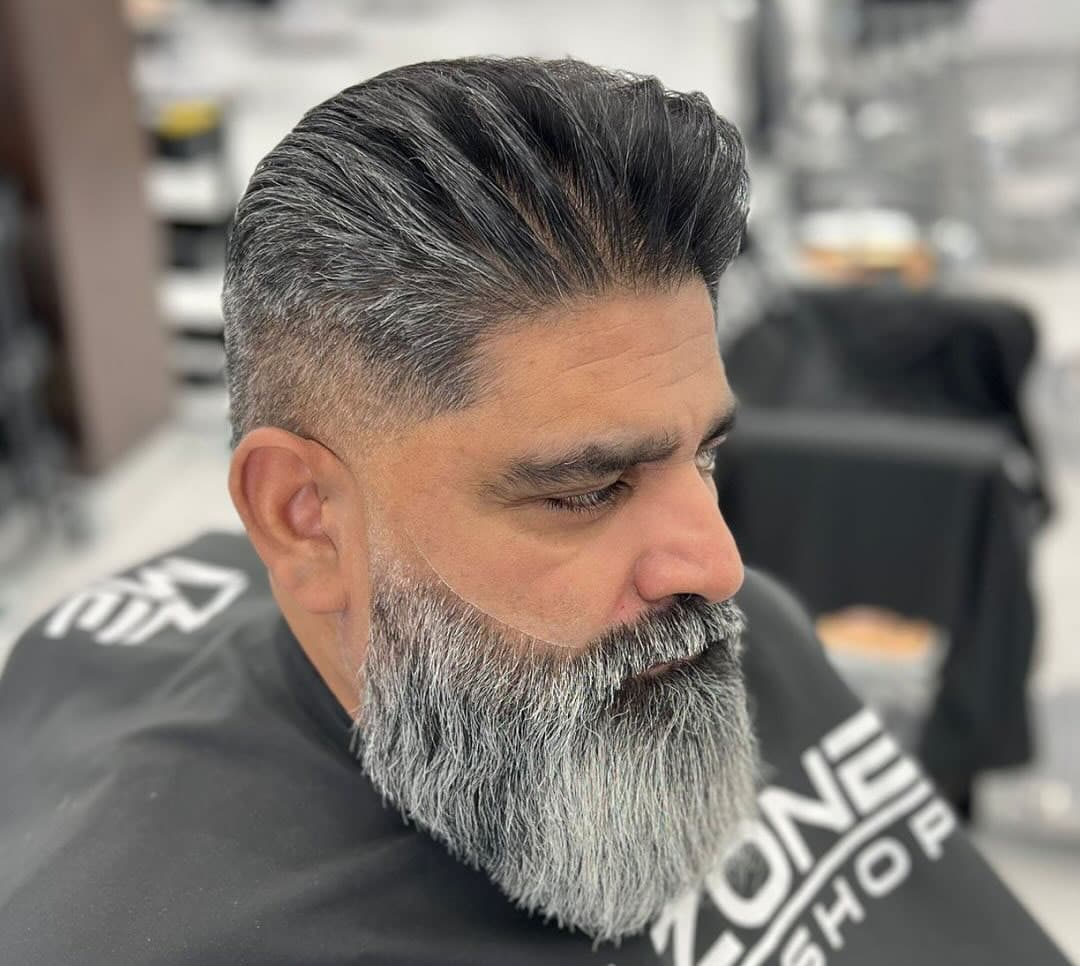
Working with Gray Hair (78% of Men Over 40)
78% of our clients ages 40-60 have some gray hair. Gray hair isn't a problem to solve—it's a texture change that requires different styling approaches. Here's what actually works.
How Gray Hair Changes Everything
What Happens When Hair Goes Gray:
Gray hair has a thicker, wiry texture than pigmented hair. This can be an advantage—coarser hair holds style better without products.
Gray hair produces less natural oil. It feels drier, can look dull, and requires different moisturizing approaches than younger hair.
Gray shows growth lines more clearly than darker hair. This is why men with gray hair often need haircuts every 2.5 weeks vs 3+ weeks for darker hair.
White/gray hair can develop yellow tones from water minerals, products, or environmental factors. This makes hair look dull or aged.
Gray hair looks especially sophisticated in classic styles (side parts, short professional cuts) and can look washed-out in certain modern styles.
Best Haircuts for Gray Hair
Haircuts That Look BETTER with Gray Hair:
Haircuts That Can Look Washed Out with Gray Hair:
- • High-volume quiffs or pompadours: Can look dated or try-hard with gray hair
- • Bleached/highlighted looks: Gray + artificial highlights = confusing color story
- • Long, flowing styles: Gray hair over 4 inches can look thin, stringy, or unkempt
- • Extreme fades with long tops: High contrast can emphasize aging rather than sophistication
Caring for Gray Hair (What Actually Works)
Do This:
- Use purple/silver shampoo 1x/week — Removes yellow tones, keeps gray bright and clean-looking
- Condition more, shampoo less — Gray hair is drier. Condition 3-4x/week, shampoo 2-3x/week max
- Use leave-in conditioner or oil — Small amount after washing adds moisture, prevents dry look
- Get cuts every 2.5 weeks — Gray shows growth faster; more frequent cuts = sharper appearance
- Embrace it completely — Fully gray looks better than patchy gray/dark. If you're 50%+ gray, let it finish naturally.
Avoid This:
- Daily shampooing — Strips natural oils from already-dry gray hair
- Heavy styling products — Can make gray hair look yellow or dirty. Use lightweight products.
- Dyeing hair darker after 50% gray — Looks unnatural, requires constant maintenance, ages you
- Hot water when washing — Dries gray hair further. Use lukewarm water.
- Skipping cuts to "save money" — Overgrown gray looks unkempt faster than overgrown dark hair
The Dyeing Question: Should You Color Gray Hair?
This is personal, but here's what we observe at Therapeutic Cuts:
Dyeing Works Well When:
- • You're under 50 and less than 30% gray
- • You have time/budget for touch-ups every 3-4 weeks
- • You use professional coloring (not box dye)
- • Your career benefits from looking younger (entertainment, sales)
Dyeing Becomes Problematic When:
- • You're over 50% gray (maintenance becomes weekly)
- • Hair is thinning (dye emphasizes scalp contrast)
- • You skip touch-ups (roots look unkempt, not distinguished)
- • You use box dye (often looks unnatural, damages hair)
Our observation: Men who fully embrace gray hair (rather than fighting it with dye or trying to hide it) report higher confidence and lower grooming stress. Gray is only a liability if you treat it like one. Styled well with appropriate haircuts, gray hair is a professional asset for men over 40.
Common Haircut Mistakes Men Over 40 Make
After cutting hair for thousands of men ages 40-60, we see these same mistakes repeatedly. Here's what to avoid:
Mistake #1: Keeping the Same Haircut from Your 30s
The Problem:
Your hair has changed—density, texture, growth pattern. What looked great at 32 can look thin, dated, or unkempt at 45. Many men don't realize their haircut has stopped working because the change is gradual.
The Fix:
Reassess your haircut every 5 years after 40. Ask your barber: "Is this still working for my current hair?" Be open to adjustments—shorter length, different fade height, or new styles designed for mature hair.
Mistake #2: Fighting Thinning Hair with Length
The Problem:
The instinct is to keep hair longer to "cover" thinning areas. This backfires—longer hair on thin areas creates transparency and makes the problem more visible. Styling also becomes harder and more time-consuming.
The Fix:
Go shorter, not longer. Keep top length under 2 inches when dealing with thinning. Consider textured crops (disguise density loss) or buzz cuts (remove the problem entirely). Shorter = more density illusion.
Mistake #3: Choosing Trendy Cuts Over Timeless Styles
The Problem:
Undercuts with extreme contrast, high-volume quiffs, man buns—these trend hard and then look dated. A 42-year-old with a 2015 undercut looks stuck in time, not stylish. Trendy cuts can also look try-hard after 40.
The Fix:
Choose classic cuts with modern execution. Side parts, textured crops, short professional cuts—these have staying power. You want a haircut that looks good in photos 5 years from now, not one that screams "2024."
Mistake #4: Stretching Time Between Cuts to "Save Money"
The Problem:
Going 4-5 weeks between cuts when your style needs 2.5-3 weeks. Gray hair and fades show growth faster. The cost of looking unkempt in professional settings far exceeds the $45 you're "saving."
The Fix:
Match your cut frequency to your style requirements. Use package deals ($38/cut vs $45) to reduce per-cut costs. Or choose styles that last longer (short professional cuts can go 3-4 weeks).
Mistake #5: Using the Wrong Products (or Too Many Products)
The Problem:
Heavy gels and pomades that worked in your 20s-30s weigh down thinning hair and make scalp more visible. Or using 4-5 products when 1-2 would suffice. Gray hair especially looks dirty with heavy, shiny products.
The Fix:
Switch to lightweight, matte products after 40. For thinning hair: sea salt spray or light clay. For gray hair: minimal product (coarse texture holds style naturally). One good product beats five mediocre ones.
Mistake #6: Not Communicating Changes to Your Barber
The Problem:
Your barber gives you the same cut every time because you never mention your hair is thinning, you're frustrated with styling time, or you don't like how it's growing out. Barbers aren't mind readers.
The Fix:
Be specific about what's not working: "I'm noticing thinning at the crown," "Styling takes too long," "It looks messy after 2 weeks." Good barbers will adjust. At Therapeutic Cuts, we ask these questions proactively.
Frequently Asked Questions
What are the best haircuts for men over 40?
The best haircuts for men over 40 are classic side part (28% of clients ages 40-60), textured crop (22%), short professional cut (18%), slicked back (16%), modern pompadour (10%), and buzz cut variations (6%). These styles work with thinning hair, gray hair, and receding hairlines while maintaining professional appearance. At Therapeutic Cuts in Queens NYC, 68% of clients over 40 choose fade-based cuts for low maintenance and clean appearance.
How should men over 40 style their hair?
Men over 40 should focus on low-maintenance styling that takes 5-8 minutes daily. Use lightweight products (medium-hold pomades or clays), avoid heavy gels that can look dated, work with natural hair patterns rather than fighting them, and get regular trims every 2.5-3 weeks. The key is sophisticated simplicity—styles that look polished without appearing over-styled or trying too hard.
What haircut is best for men over 40 with thinning hair?
For thinning hair over 40, the best options are short textured crop with mid fade (works for 85% of thinning patterns), buzz cut variations (0.5-1 inch length), low-maintenance crew cut, or strategic side part that works with natural density. Avoid: comb-overs, excessive length on top (creates transparency), hard parts through thin areas, and slicked-back styles that expose scalp. At Therapeutic Cuts, we recommend keeping length under 2 inches when working with thinning hair.
Should men over 40 get a fade haircut?
Yes—68% of men over 40 at Therapeutic Cuts choose fade haircuts because they're low-maintenance, age-appropriate, and work well with gray hair and changing hairlines. Mid fades (42%) and low fades (38%) are most popular for professional appearance. Fades create clean lines, reduce styling time, and look sophisticated rather than trendy. They're particularly effective for men with thinning hair or receding hairlines, as the gradual taper creates balanced proportions.
How often should men over 40 get haircuts?
Men over 40 should get haircuts every 2.5-3 weeks for fade-based cuts, or every 4-5 weeks for longer styles without fades. More frequent cuts are needed as you age because gray hair shows growth lines more visibly, professional appearance requires sharper maintenance, and hair texture changes can make styles look unkempt faster. At Therapeutic Cuts, 72% of clients over 40 maintain 2.5-3 week schedules with package deals ($38/cut vs $45 regular pricing).
What should men over 40 avoid in haircuts?
Men over 40 should avoid: trendy cuts that will look dated quickly (high-volume quiffs, extreme undercuts), excessive length that exposes thinning, overly styled looks that appear try-hard, harsh lines that emphasize receding hairlines, outdated styles (spiky gelled looks from the 2000s), and cuts requiring 15+ minutes daily styling. Focus instead on timeless, low-maintenance styles that work with your natural hair characteristics and professional lifestyle.
How much do haircuts for men over 40 cost in Queens NYC?
In Queens NYC, haircuts for men over 40 cost $45-50 for standard cuts with fades at Therapeutic Cuts. Annual costs: $774-945 with standard pricing, or $696-805 with package deals (saves $78-140/year). Package deals offer 10 cuts for $380 ($38/cut). Gray hair coverage or specialized thinning hair consultations may add $10-15 to initial appointments. Most men over 40 maintain 2.5-3 week schedules, averaging 18-21 cuts per year.
Are side parts appropriate for men over 40?
Yes—side parts are the #1 choice for men over 40, representing 28% of clients ages 40-60 at Therapeutic Cuts. Side parts offer timeless sophistication, work well with professional environments (finance, law, healthcare), disguise thinning crowns effectively, and adapt to gray hair naturally. The classic side part with low or mid fade has been the professional standard since the 1920s and never looks dated. Average client age for side parts is 44, making it perfectly age-appropriate.
Ready for an Age-Appropriate Haircut That Works?
Join the 4,200+ men over 40 in Queens NYC who trust Therapeutic Cuts for professional, low-maintenance haircuts designed for mature hair.
📍 Astoria, Queens • Serving ages 40-60 for 8+ years • Specialized in thinning hair and gray hair
Related Guides for Men Over 40
Fade with Side Part Guide
The #1 choice for men over 40. Complete styling guide and cost breakdown.
Textured Crop Guide
Best haircut for thinning hair. Works for 85% of thinning patterns.
Slicked Back Guide
Executive power move for men with good density. Full styling breakdown.
Mid Fade Guide
The most popular fade height for men over 40. Versatile and professional.
Low Fade Guide
Conservative, professional, lasts 3 weeks. Perfect for traditional industries.
Scalp Micropigmentation
Non-surgical solution for advanced thinning. Creates density illusion.